About 323 minutes
The Thirteen Travellers — Themes and Context
Historical Psychological Social Fiction
74,080 recorded words. 2 minutes difference from this book's estimate.
View Gutenberg source #60278
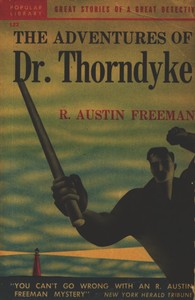
The source record for The adventures of Dr. Thorndyke (The singing bone) — Edition Insights measures this digital text at 73,704 words, 5 hr 21 min estimated reading time, and 7 detected text sections.
The text analysis averages about 17.2 words per sentence, while the detected sections provide another way to judge how the source is divided.
Project Gutenberg metadata also associates the work with “London (England) -- Fiction,” connecting these edition facts with the source record’s subject description.
Explore this collection
These alternatives are selected using recorded categories and estimated reading time.
About 323 minutes
Historical Psychological Social Fiction
74,080 recorded words. 2 minutes difference from this book's estimate.
View Gutenberg source #60278About 330 minutes
Historical Psychological Social Fiction
75,704 recorded words. 9 minutes difference from this book's estimate.
View Gutenberg source #56932About 332 minutes
Historical Psychological Social Fiction
76,187 recorded words. 11 minutes difference from this book's estimate.
View Gutenberg source #58944Search stored excerpts and compare books → Choose by your preferences →
Choices use stored catalog measurements. Estimates vary with reading speed. A shared category is a catalog label, not a claim that two books have the same argument or literary quality.
Search reads excerpt text stored with this catalog and links to its associated Gutenberg record. The connection is stored in the site database; this tool does not recheck that every excerpt is word-for-word identical to that external record. Excerpt search does not cover every chapter and does not verify historical publication dates.
Catalog snapshot checked: 2026-09-25. Coverage: 97 public books, 97 available source excerpts.
Read the complete public-domain text at its original source.
Read on Project GutenbergR. Austin Freeman's collection opens with a preface that explicitly challenges the conventional detective story. Instead of concealing the criminal's identity until the end, the first four stories reverse the formula: the reader witnesses the crime and knows the perpetrator from the start. The interest, Freeman argues, shifts from 'who did it?' to 'how was it discovered?'—a focus on the unexpected significance of trivial circumstances. The fifth story, by contrast, adheres to the orthodox method, allowing readers to compare both approaches. This structural experiment is the collection's defining feature, and it shapes how each tale unfolds.
Freeman's preface lays out his rationale for the inverted structure. He believes that in fiction, the reader's curiosity is engaged less by the criminal's identity and more by the demonstration of 'unsuspected causal connections' and the evolution of ordered evidence from apparently incoherent facts. To test this, he wrote 'The Case of Oscar Brodski,' where the reader knows everything and the detective knows nothing. The success of that experiment led to three more stories of the same type. This deliberate narrative choice means that suspense is generated not by mystery but by the process of detection itself—a method that rewards close attention to detail.
In the title story, the setting is a screw-pile lighthouse on the Girdler Sand, a location Freeman notes he substituted for the actual light-vessel to avoid libel issues. The fog-bound environment creates a claustrophobic, isolated stage. The excerpt describes how 'the fog seemed to have shut out sound as well as vision,' with only the horn's bellow and the distant tolling of a bell breaking the silence. The arrival of a boat through the fog, the spectral figure, and the slow ascent up the iron ladder build tension. The lighthouse becomes a confined space where past crimes resurface, and the fog-horn's 'roar like that of some hungry monster' underscores the menace.
Across the excerpts, fog and isolation recur as atmospheric devices. In the lighthouse story, the fog muffles sound and vision, heightening the sense of entrapment. The characters' movements are described with precise, deliberate detail—the 'muffled sound of oars,' the 'shadowy figure pulling furiously,' the 'hollow clank of their footsteps on the iron plates.' These details create a palpable sense of place. The confrontation between Jeffreys (Rorke) and Todd is marked by a slow, almost theatrical reveal: the stranger's face remains hidden until the last moment, and the recognition line—'Hast thou found me, O mine enemy!'—echoes biblical language, adding weight to the encounter.
Freeman's dialogue in the excerpt is spare but charged. When Todd offers to let bygones be bygones, Rorke's response is curt: 'Sit down... and tell me what you've done with all that money.' The exchange reveals a history of betrayal and a shared secret—'that job on board the old Sea-flower'—but the details remain vague, leaving the reader to infer the crime. The dialogue avoids melodrama; instead, the tension is carried by physical actions: the wiping of a face, the start back, the silent ascent. This restraint aligns with Freeman's emphasis on evidence and causal connections rather than emotional outbursts.
Readers approaching this collection should note the structural divide: the first four stories demand attention to the detective's reasoning, not the puzzle of the criminal's identity. The fifth story offers a more familiar whodunit, providing a contrast that highlights Freeman's experimental method. Pay particular attention to the settings—lighthouses, fog, isolated spaces—and the way small, seemingly trivial details become the linchpins of Thorndyke's deductions.
That rainy afternoon, I kept thinking how Freeman’s Thorndyke found truth in the smallest overlooked gestures—a fog, a bone, a silence. Later, reaching for something lighter, I stumbled onto When she came home from college — A Closer Reading, and felt the same quiet pleasure in noticing what a person doesn’t say aloud.
Create a short personal record of your experience with this book.