About 615 minutes
The Middle of the Road: A Novel — Text and Context
Historical Psychological Social Fiction
141,341 recorded words. 26 minutes difference from this book's estimate.
View Gutenberg source #59960
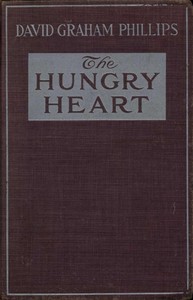
The source record for The Hungry Heart: A Novel — Reading Companion measures this digital text at 147,249 words, 10 hr 41 min estimated reading time, and 19 detected text sections.
The text analysis averages about 12.8 words per sentence, while the detected sections provide another way to judge how the source is divided.
Project Gutenberg metadata also associates the work with “Indiana -- Fiction,” connecting these edition facts with the source record’s subject description.
Explore this collection
These alternatives are selected using recorded categories and estimated reading time.
About 615 minutes
Historical Psychological Social Fiction
141,341 recorded words. 26 minutes difference from this book's estimate.
View Gutenberg source #59960About 682 minutes
Historical Psychological Social Fiction
156,672 recorded words. 41 minutes difference from this book's estimate.
View Gutenberg source #59138About 586 minutes
Historical Psychological Social Fiction
134,648 recorded words. 55 minutes difference from this book's estimate.
View Gutenberg source #53339Search stored excerpts and compare books → Choose by your preferences →
Choices use stored catalog measurements. Estimates vary with reading speed. A shared category is a catalog label, not a claim that two books have the same argument or literary quality.
Search reads excerpt text stored with this catalog and links to its associated Gutenberg record. The connection is stored in the site database; this tool does not recheck that every excerpt is word-for-word identical to that external record. Excerpt search does not cover every chapter and does not verify historical publication dates.
Catalog snapshot checked: 2026-09-25. Coverage: 97 public books, 97 available source excerpts.
Read the complete public-domain text at its original source.
Read on Project GutenbergThe novel opens with a pointed reversal: 'Where such romances end in a rosily vague "And they lived happily ever after," there this history begins.' From the first morning after the honeymoon, the reader is placed inside Courtney Vaughan's consciousness as she wakes alone in a strange house, her husband already gone. The prose lingers on sensory details—the dent in the pillow, the heavy auburn hair, the butterfly simile that recurs later—to establish a psychological realism that undercuts the fairy-tale frame. The setting, a lakeside Indiana homestead, is rendered with precise geography: 'across the narrow width of Wenona the lake from Wenona the town.' This specificity anchors the emotional drama in a tangible place.
The opening chapter introduces Courtney through a series of delicate, childlike images: she is 'small and perfect like a sun sprite,' her movements 'swift and light as a butterfly.' Yet the bed she sits in is 'big enough for half a dozen as small as she,' suggesting a disproportion between her fragility and the scale of her new life. The narrative voice shifts between her perceptions—'How considerate of him not to wake her'—and an external view that notes her 'impulsive self-unconsciousness.' This double perspective invites the reader to question her optimism. The lake, the town, the 'perfumed coolness' of the trees: all are rendered as a stage set for a happiness that the novel's premise warns may be temporary.
Later excerpts show Courtney in a very different mood. Traveling by sleigh toward Wenona, she reflects on 'right and wrong, not two straight paths, one up, the other down, but a tangle, a maze, a labyrinth.' The passage introduces a philosophical turn: she sees herself as living in 'this era of transition,' where old dogmas have crumbled and no new moral guidance has replaced them. Her plan with Basil—to leave her husband and begin a new life—is framed as a 'compromise,' a 'thistle with fig grafts.' The narrative does not endorse or condemn her reasoning; instead, it presents her self-justification as a kind of 'moral exaltation' that might fool a saint. The sleigh bells that once echoed in her 'happy heart' now accompany a more complex resolve.
The title phrase 'hungry heart' does not appear in the excerpts, but the concept pervades them. Courtney's initial joy is described as a 'forlorn sigh like a disappointed child' when she finds her husband gone. Later, her happiness at the sleigh ride is so intense that 'the tears were in her eyes and the sobs in her throat.' The narrative repeatedly emphasizes a yearning that cannot be satisfied by circumstance. Even the landscape participates: the lake, the snow, the 'grand old trees' are described with a fullness that contrasts with the characters' inner emptiness. This pattern of emotional extremes—from butterfly lightness to tearful exaltation—suggests a character driven by an appetite that the plot may test.
Phillips employs a close third-person narration that often merges with Courtney's thoughts, yet maintains a subtle distance. Phrases like 'she suggested a butterfly poised motionless' or 'she was in a mood of moral exaltation that might have stirred the enthusiasm of a saint' carry a hint of irony. The structure of the excerpts—beginning with the morning-after scene, jumping to the sleigh ride, then to the moral reflection—suggests a novel that moves between intimate domestic moments and broader social commentary. The reader is given access to Courtney's rationalizations without being told how to judge them. This technique, combined with the novel's length (over 147,000 words), indicates a slow, psychological unfolding rather than rapid plot advancement.
These excerpts reveal a novel more concerned with interior states than external events. The reader should attend to the shifts in Courtney's self-awareness and the narrator's quiet judgments. The recurring imagery—butterflies, sleigh bells, the lake—functions as a barometer of her emotional weather. Phillips's prose rewards careful reading of its rhythmic sentences and precise physical details. The story's moral complexity is established early and deepens; the excerpts offer no resolution, only a deepening of the central conflict between desire and convention.
Reading the opening of The Hungry Heart, I remembered sitting with my mother's old paperback, wondering if Courtney's restlessness ever quieted. It made me think of a quieter ache I found in When she came home from college — A Closer Reading, where home feels like a room you've outgrown but can't leave. That same hunger, just whispered softer.
Build a private reading journal entry for this title.