About 222 minutes
When she came home from college — A Closer Reading
Historical Psychological Social Fiction
51,054 recorded words. 7 minutes difference from this book's estimate.
View Gutenberg source #54033
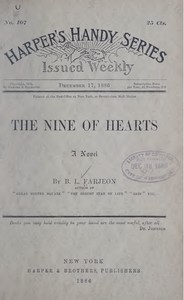
Before opening The Nine of Hearts: A Novel — Reading Notes, the edition data offers a quick orientation: 49,343 words, 3 hr 35 min estimated reading time, and 6 detected text sections.
The text analysis averages about 13.3 words per sentence, while the detected sections provide another way to judge how the source is divided.
Project Gutenberg metadata also associates the work with “London (England) -- Fiction,” connecting these edition facts with the source record’s subject description.
Explore this collection
These alternatives are selected using recorded categories and estimated reading time.
About 222 minutes
Historical Psychological Social Fiction
51,054 recorded words. 7 minutes difference from this book's estimate.
View Gutenberg source #54033About 222 minutes
Historical Psychological Social Fiction
50,888 recorded words. 7 minutes difference from this book's estimate.
View Gutenberg source #60099About 226 minutes
Historical Psychological Social Fiction
51,820 recorded words. 11 minutes difference from this book's estimate.
View Gutenberg source #57613Search stored excerpts and compare books → Choose by your preferences →
Choices use stored catalog measurements. Estimates vary with reading speed. A shared category is a catalog label, not a claim that two books have the same argument or literary quality.
Search reads excerpt text stored with this catalog and links to its associated Gutenberg record. The connection is stored in the site database; this tool does not recheck that every excerpt is word-for-word identical to that external record. Excerpt search does not cover every chapter and does not verify historical publication dates.
Catalog snapshot checked: 2026-09-25. Coverage: 97 public books, 97 available source excerpts.
Read the complete public-domain text at its original source.
Read on Project GutenbergThe novel begins not with a crime but with a courtroom scene: the third day of Edward Layton's trial for the murder of his wife, Agnes. The prisoner, after briefly accepting counsel, abruptly insists on conducting his own defense, a decision his lawyer describes as 'very reluctantly given.' This opening establishes a central tension—Layton's stubborn secrecy—and immediately raises questions about his motives and guilt.
The trial narrative is interspersed with testimony from a coachman, a waiter, a detective, and a lady's maid, each offering fragmented perspectives. The detective's evidence introduces the titular 'Nine of Hearts,' a playing card that becomes a cryptic clue. The structure, with its shifting viewpoints and legal formalities, invites readers to piece together the mystery alongside the jury.
The opening chapter, 'A Strange Decision,' centers on Layton's insistence on self-representation. His counsel, Mr. Bainbridge, tells the court that the prisoner 'has resolved not to be defended or represented by counsel.' This is not a mere legal maneuver; it signals a deeper resolve. In a later prison visit, Bainbridge recounts Layton's declaration: 'Upon my next trial I shall defend myself, as I did on my last. I will accept no legal assistance whatever.'
The excerpts show Layton as a man who 'doggedly' conceals something. When Bainbridge asks if he recognizes any juror, Layton claims short-sightedness and denies knowing them. Yet the detective's earlier testimony notes that Layton 'leaned forward and gazed at the jury with an appearance of eagerness' when they returned undecided. This contradiction—between Layton's professed indifference and his visible reaction—is a small but telling detail that readers should watch for.
Detective Lumley Rich's evidence introduces the 'Nine of Hearts' as a physical object tied to the case. The card itself is not described in the excerpts, but its appearance in the trial suggests it is a key piece of evidence. Rich's testimony is placed fourth in the trial sequence, after the coachman and waiter, implying a build-up of circumstantial facts before a more concrete clue.
Rich also recounts his interactions with Layton before the trial. He notes that Layton was 'unaffectedly glad to see me' but remained guarded. When Rich asks if Layton knows the juror who favored him, Layton replies, 'I am quite ignorant of the names of the jurymen.' Yet Rich's earlier observation of Layton's eagerness hints at a possible recognition. The detective's suspicion that Layton 'knew something which he was doggedly concealing' frames the card as a potential key to that secret.
The trial is presented through a mix of direct testimony and third-person reportage. The opening chapter is narrated in a journalistic style, with phrases like 'Extraordinary as was the excitement' and 'the widely spread rumor.' This detached voice contrasts with the emotional intensity of the prisoner's exchanges. When Layton tells Bainbridge, 'I am innocent of the horrible charge,' and weeps, the reader is given a moment of apparent sincerity. But the narrative undercuts it: Bainbridge admits he felt 'it necessary to be on my guard with him.'
The excerpts do not reveal the trial's outcome, only that the jury disagreed (eleven for conviction, one for acquittal). This hung jury leaves Layton's guilt unresolved, forcing readers to weigh the evidence themselves. The novel's structure—moving from trial to a 'Cable Message from America' and then to 'The Mystery of the Nine of Hearts'—suggests that the card's significance will unfold beyond the courtroom.
The story is set in London, as indicated by the catalog subject 'London (England) -- Fiction.' The trial takes place at the 'Central Criminal Court' (the Old Bailey), and the characters include a coachman, a waiter, a lady's maid, and a detective—figures from different social strata. The legal proceedings are formal, with references to Q.C.s, 'your lordship,' and the jury's deliberation.
The excerpts also hint at a domestic tragedy: Layton is accused of poisoning his wife with 'narcotics' on a specific date, March 26. The lady's maid, Ida White, is listed as a witness, suggesting that the household staff may provide crucial testimony. The setting of a Victorian murder trial, with its public spectacle and rigid procedures, shapes the narrative's pace and the reader's sense of suspense. The novel's division into parts—trial, cable message, mystery—indicates a shift from legal drama to investigative pursuit.
As you read, pay close attention to what Layton does not say. His silences, his evasions, and his sudden decisions are as telling as any testimony. The nine of hearts appears early but its meaning remains obscure; track every mention of the card across the trial and later sections. The novel rewards careful observation of small inconsistencies—like Layton's claim of short-sightedness versus his eager gaze—that may unravel the mystery.
I found myself thinking about The Nine of Hearts this evening, remembering how Layton’s quiet defiance in that courtroom lingered. That hidden card, the private weight of a secret—it carried me somewhere softer, to a sense of waiting rather than conflict. Odd how The Land of Content — Edition Insights came to mind then, as if both books shared a breath held between intentions and what remains unspoken.
Use these questions to collect your thoughts before moving on.