About 373 minutes
The Land of Joy — Background and Themes
Historical Psychological Social Fiction
85,708 recorded words. 5 minutes difference from this book's estimate.
View Gutenberg source #57497
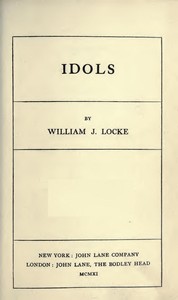
Before opening Idols — Themes and Context, the edition data offers a quick orientation: 84,533 words, 6 hr 8 min estimated reading time, and 10 detected text sections.
The text analysis averages about 12.5 words per sentence, while the detected sections provide another way to judge how the source is divided.
Project Gutenberg metadata also associates the work with “London (England) -- Fiction,” connecting these edition facts with the source record’s subject description.
Explore this collection
These alternatives are selected using recorded categories and estimated reading time.
About 373 minutes
Historical Psychological Social Fiction
85,708 recorded words. 5 minutes difference from this book's estimate.
View Gutenberg source #57497About 376 minutes
Historical Psychological Social Fiction
86,321 recorded words. 8 minutes difference from this book's estimate.
View Gutenberg source #56562About 383 minutes
Historical Psychological Social Fiction
87,914 recorded words. 15 minutes difference from this book's estimate.
View Gutenberg source #52715Search stored excerpts and compare books → Choose by your preferences →
Choices use stored catalog measurements. Estimates vary with reading speed. A shared category is a catalog label, not a claim that two books have the same argument or literary quality.
Search reads excerpt text stored with this catalog and links to its associated Gutenberg record. The connection is stored in the site database; this tool does not recheck that every excerpt is word-for-word identical to that external record. Excerpt search does not cover every chapter and does not verify historical publication dates.
Catalog snapshot checked: 2026-09-25. Coverage: 97 public books, 97 available source excerpts.
Read the complete public-domain text at its original source.
Read on Project GutenbergThe proem of Idols introduces two nameless burglars who murder an old man and vanish, only to be caught later. Locke immediately shifts focus: the crime matters only as a catalyst for “convulsions in other lives.” The narrative then opens on Irene Merriam, a woman who “gave unsparingly of herself to life, and made large claims upon life in return,” sitting contentedly after dinner with her husband Gerard and his lifelong friend. The scene is domestic, familiar, and deliberately ordinary—a contrast to the violent spark that will ignite it.
Catalog subjects list London, man-woman relationships, murder, divorce, and trials. The excerpts confirm a murder trial but also reveal a psychological emphasis: Irene’s interior state, her dependence on Gerard, and the slow revelation of hidden tensions. The proem’s language of “smouldering train of devastating forces” and “stifled passions” signals that the plot is less about the crime itself than its impact on a closed circle.
The proem is not a chapter but a separate, titled section—PROEM—that establishes a fatalistic framework. Locke writes that the two murderers were “blind, almost impersonal instruments of Destiny.” This language of inevitability colors the entire excerpt. The crime is described in a single paragraph; its perpetrators are dismissed as “sordid” and forgotten. The real subject is the “four gentle lives” beneath which a train was smouldering. This structure suggests that the novel will not dwell on the mechanics of detection or punishment but on the psychological and social aftermath. The proem’s tone—elegiac, almost philosophical—contrasts with the concrete domestic scene that follows in Chapter I, where Irene’s “hour of greatest content” is described in detail. The juxtaposition implies that the contentment is fragile, and the reader is primed for disruption.
The excerpts are focalized through Irene Merriam. We see her listening to the men talk, “preferring to watch the play of expression on their faces, to dream dreams about them.” Later, during the trial, her sensory experience dominates: the air “impregnated with the odour of the gaol,” the judge’s “obscured profile,” Hugh’s face buried in his arms. She becomes lost in the Old Bailey, waiting in the wrong lobby. The narrative follows her confusion and anxiety, not the legal proceedings. The catalog subject “Trials (Murder)” is present, but the excerpts show the trial as a subjective ordeal rather than a procedural one. Irene’s search for Gerard after her testimony—she “would have given a year of her life for Gerard’s protecting presence”—suggests a marital dynamic that may be central, but the excerpts do not reveal Gerard’s motives or the outcome. The reader is left with Irene’s limited knowledge.
Two small details recur in the excerpts. First, the latch-key: Hugh, the accused, “possessed a latch-key” to the Merriam household, a fact that goes unquestioned in court. This object implies intimacy and trust, yet it is introduced in a legal context, hinting at betrayal or hidden relationships. Second, waiting and disorientation: Irene waits in the wrong lobby, “like a fool,” while Gerard disappears. Earlier, she waits contentedly by the fire; later, she waits in “torture of anxiety.” The physical layout of the Old Bailey—worn stairs, gloomy corridors, a wrong door—mirrors her emotional state. The policeman’s indulgence and the old man beside her, who rises “in weary obedience,” underscore her isolation. These recurring elements—a key, a wrong turn, a wait—are concrete and traceable, suggesting that Locke uses small, tangible details to build tension and character.
The excerpts offer a narrow but vivid window into Idols: a domestic world disrupted by a trial, seen through a wife’s eyes. Readers should note that the catalog subject “Divorce” does not appear in the provided text, and the nature of the relationship between Irene, Gerard, and Hugh remains ambiguous. The proem’s deterministic framing may or may not hold through the full novel. Approach the text as a psychological study of a marriage under pressure, not a conventional mystery or courtroom drama.
Reading Idols — Themes and Context, I lingered on Irene’s quiet unraveling, how a familiar room turns strange under suspicion. That same intimacy, the ache of shared history, came back to me later, almost like a whisper, when I opened Neighbours on the Green — A Reader’s Guide. The proximity in both feels less like plotting, more like weather that settles over the characters.
Capture what you thought, learned, and would like to remember.