About 383 minutes
With Force and Arms: A Tale of Love and Salem Witchcraft — Edition Insights
Historical Psychological Social Fiction
87,894 recorded words. 0 minutes difference from this book's estimate.
View Gutenberg source #54371
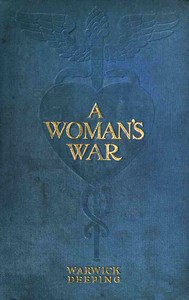
Before opening A Woman's War: A Novel — A Closer Reading, the edition data offers a quick orientation: 87,914 words, 6 hr 23 min estimated reading time, and 13 detected text sections.
The text analysis averages about 13.6 words per sentence, while the detected sections provide another way to judge how the source is divided.
Project Gutenberg metadata also associates the work with “City and town life -- Fiction,” connecting these edition facts with the source record’s subject description.
Explore this collection
These alternatives are selected using recorded categories and estimated reading time.
About 383 minutes
Historical Psychological Social Fiction
87,894 recorded words. 0 minutes difference from this book's estimate.
View Gutenberg source #54371About 376 minutes
Historical Psychological Social Fiction
86,321 recorded words. 7 minutes difference from this book's estimate.
View Gutenberg source #56562About 373 minutes
Historical Psychological Social Fiction
85,708 recorded words. 10 minutes difference from this book's estimate.
View Gutenberg source #57497Search stored excerpts and compare books → Choose by your preferences →
Choices use stored catalog measurements. Estimates vary with reading speed. A shared category is a catalog label, not a claim that two books have the same argument or literary quality.
Search reads excerpt text stored with this catalog and links to its associated Gutenberg record. The connection is stored in the site database; this tool does not recheck that every excerpt is word-for-word identical to that external record. Excerpt search does not cover every chapter and does not verify historical publication dates.
Catalog snapshot checked: 2026-09-25. Coverage: 97 public books, 97 available source excerpts.
Read the complete public-domain text at its original source.
Read on Project GutenbergThe opening pages of A Woman's War establish a rhythm of quiet domesticity and sudden tension. Catherine Murchison returns home on a frosty night, the moon shining on cypresses and chimney-stacks, and the brass lion's-head on her door seems to welcome her. The prose moves at a measured pace, lingering on the warmth of the hall, the red-silk lamp, the old Dutch chair. But within a few chapters, the same household is thrown into disorder by a child's fever and a husband's anxiety. The narrative voice shifts from serene description to clipped, urgent dialogue—'What has upset her, Kate?'—and the contrast between these two registers becomes a key structural device.
The novel's early chapters are built on careful, almost painterly description. The frosty air, the 'white window-sashes,' the 'Oriental rugs covering the mellow and much polished parquetry'—these details create a sense of order and comfort. Catherine's contentment is rendered through her surroundings: she 'looked round her with a breathing in of deep content.' Yet this stability is fragile. The transition from the opening tableau to the scene of Gwen's illness is abrupt. The child's 'half-fretful eyes' and 'hurrying heart' introduce a new tempo. The doctor-husband, James Murchison, reads symptoms where his wife sees only tiredness. The prose tightens, sentences shorten, and the domestic calm gives way to a medical alertness that will recur throughout the book.
Deeping uses dialogue to reveal character and conceal emotion. Catherine's speech is often gentle and evasive—'Nothing, dear, nothing'—while her husband's questions are direct and anxious. The children's voices are distinct: Jack's defiant 'Sha'n't' and Gwen's tearful 'I—I's tired, father.' But what is left unsaid matters as much. When Catherine tells James that Jack has been teasing Gwen, she 'could find no more to say against her son.' The pause suggests a reluctance to blame, or a deeper worry she cannot articulate. Later, Jack's confession—'I tore my knickers'—is a comic deflection, but Catherine 'took the confession in the spirit that it was given,' accepting the boy's attempt at reconciliation. These small verbal exchanges build a pattern of restraint and indirectness that defines the family's interactions.
Roxton, the fictional town, is more than a backdrop. The opening chapter establishes its geography: King's Walk, Lombard Street, St. Antonia's steeple. The 'great red-brick house' with its 'Georgian air of solidity' is a symbol of professional success and domestic security. But the setting also carries a countercurrent. The 'shawl-clad figures' gliding under the cypresses suggest a world of servants and social obligations. The 'frosty air' and 'hard, moonlit sky' hint at coldness beneath the surface. Later, the pantomime scene—'forty fairies in green and crimson'—contrasts sharply with the earlier stillness, but Gwen's silence there ('sat silent and solemn-eyed') suggests that even public pleasure is shadowed by private strain. The physical environment consistently mirrors the emotional weather of the characters.
The excerpts show a deliberate alternation between slow, sensory passages and rapid, event-driven scenes. The opening paragraph of Chapter I is a single, flowing sentence that moves from chimes to moonlight to hoar-frost. By contrast, the scene of Gwen's illness is built from short, staccato exchanges: 'Tired, little one, eh?' 'Yes, very tired.' This shift in pace signals a change in narrative focus—from atmosphere to action, from observation to crisis. What remains unseen is equally important. The reader does not witness the pantomime itself, only its effect on the children. The novel's title, A Woman's War, suggests a conflict that is largely internal, fought in the spaces between words and in the quiet adjustments of daily life.
Readers attentive to shifts in tempo and tone will find that Deeping's novel rewards close attention to its silences. The narrative moves between the measured and the urgent, the descriptive and the dialogic, without ever losing its focus on the Murchison household. The war of the title is not fought on a battlefield but in the intervals of a doctor's day, in the pauses between a child's tears and a husband's worry. To read A Woman's War is to watch a family navigate the small, cumulative pressures that shape a life.
This book’s quiet rooms, where every glance holds a tremor before the doctor arrives, reminds me of sitting with my grandmother. She’d read Robin Linnet — A Closer Reading aloud, her voice catching on the same unspoken grief. Both feel like holding a warm stone—heavy, but gentle in the palm. I miss that hush.
A brief reflection can help important ideas stay with you longer.