About 173 minutes
A Gray Eye or So. In Three Volumes—Volume II — Background and Themes
Historical Psychological Social Fiction
39,729 recorded words. 1 minutes difference from this book's estimate.
View Gutenberg source #51945
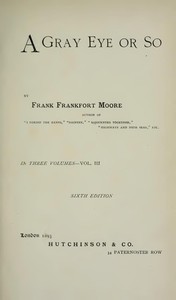
A Gray Eye or So. In Three Volumes—Volume III — A Reader’s Guide can be approached with a clearer sense of reading commitment from its source measurements: 39,938 words, 2 hr 54 min estimated reading time, and 6 detected text sections.
The text analysis averages about 15.4 words per sentence, while the detected sections provide another way to judge how the source is divided.
Project Gutenberg metadata also associates the work with “Mate selection -- Fiction,” connecting these edition facts with the source record’s subject description.
Explore this collection
These alternatives are selected using recorded categories and estimated reading time.
About 173 minutes
Historical Psychological Social Fiction
39,729 recorded words. 1 minutes difference from this book's estimate.
View Gutenberg source #51945About 177 minutes
Historical Psychological Social Fiction
40,553 recorded words. 3 minutes difference from this book's estimate.
View Gutenberg source #58433About 164 minutes
Historical Psychological Social Fiction
37,616 recorded words. 10 minutes difference from this book's estimate.
View Gutenberg source #49621Search stored excerpts and compare books → Choose by your preferences →
Choices use stored catalog measurements. Estimates vary with reading speed. A shared category is a catalog label, not a claim that two books have the same argument or literary quality.
Search reads excerpt text stored with this catalog and links to its associated Gutenberg record. The connection is stored in the site database; this tool does not recheck that every excerpt is word-for-word identical to that external record. Excerpt search does not cover every chapter and does not verify historical publication dates.
Catalog snapshot checked: 2026-09-25. Coverage: 97 public books, 97 available source excerpts.
Read the complete public-domain text at its original source.
Read on Project GutenbergThe third volume of A Gray Eye or So opens with a marriage proposal that is less a declaration of love than a desperate bid for security. Harold, pale and haggard after a sleepless night, asks his beloved to marry him “to-morrow—to-day—this moment.” The woman’s response—immediate, trusting, and tearful—contrasts sharply with the mundane sounds of a fishmonger’s boy joking with a cook outside the window. This juxtaposition of high emotion and everyday life sets the tone for a volume that repeatedly tests romantic ideals against social realities.
The opening scene establishes a pattern of urgent, conditional proposals. Harold’s plea—“I want to feel that you are my own—my own beyond the possibility of being separated”—suggests fear rather than confidence. The woman’s love “which casteth out fear” is tested by his unexplained urgency. Later, a conversation between Helen Craven and Edmund Airey dissects another potential match: whether Lord Fotheringay will propose to Beatrice Avon now that he has inherited a title and income. Helen’s cool analysis—“Either would be quite enough to marry and live on”—reduces marriage to a transaction. Edmund’s feigned surprise at her directness reveals how thoroughly social calculation pervades even intimate decisions.
Dialogue in this volume operates as a form of social chess. Helen Craven’s remark that Beatrice Avon might accept Edmund “if you give her a chance” is delivered with studied casualness, yet it carries the force of a gambit. Edmund’s “well simulated” start and “opening of his eyes” show that both speakers are performing. The narrator notes that Helen “had merely guessed” that Edmund called on Beatrice, yet her guess is presented as fact. This subtle manipulation of information—what is said, what is withheld, what is inferred—drives the plot forward. Even the chapter titles, such as “On a Knowledge of the World” and “On Society and the Seal,” signal that conversation is the arena where power and affection are negotiated.
A murder occurs just outside the house where the characters are guests, but the narrative does not dwell on the act itself. Instead, attention shifts to its social repercussions: who inherits the title, who might now marry whom, and how the event reflects on the company. Helen Craven’s ability to “discuss its social bearing” within hours of the tragedy marks her as a particular type—admired by Edmund for her composure. The murder becomes a catalyst for romantic and financial recalibration. The narrator’s ironic tone, especially in chapter titles like “On Murder as a Social Incident,” underscores the gap between violent reality and the polite world’s absorption of it into gossip and strategy.
Readers approaching this volume should attend to the spaces between what characters say aloud and what they think. Moore’s chapter headings, each beginning “On…,” promise essays but deliver scenes that undercut abstract moralizing with concrete social maneuvering. The novel’s interest lies less in the outcome of courtships than in the precise, often unspoken calculations that shape them.
The rain kept time with that brittle proposal scene in A Gray Eye or So—how duty and calculation can masquerade as love. Later, drying the pages, I pulled another book off the shelf almost without thinking, and found a softer, more patient answer to the same question. Peter Paragon: A Tale of Youth — Edition Insights felt like a quiet exhale after that tight Victorian breath.
Create a short personal record of your experience with this book.