About 174 minutes
A Gray Eye or So. In Three Volumes—Volume III — A Reader’s Guide
Historical Psychological Social Fiction
39,938 recorded words. 1 minutes difference from this book's estimate.
View Gutenberg source #51946
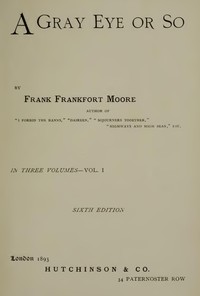
For A Gray Eye or So. In Three Volumes—Volume II — Background and Themes, the stored edition analysis reports 39,729 words, 2 hr 53 min estimated reading time, and 5 detected text sections.
The text analysis averages about 18.8 words per sentence, while the detected sections provide another way to judge how the source is divided.
Project Gutenberg metadata also associates the work with “Mate selection -- Fiction,” connecting these edition facts with the source record’s subject description.
Explore this collection
These alternatives are selected using recorded categories and estimated reading time.
About 174 minutes
Historical Psychological Social Fiction
39,938 recorded words. 1 minutes difference from this book's estimate.
View Gutenberg source #51946About 177 minutes
Historical Psychological Social Fiction
40,553 recorded words. 4 minutes difference from this book's estimate.
View Gutenberg source #58433About 164 minutes
Historical Psychological Social Fiction
37,616 recorded words. 9 minutes difference from this book's estimate.
View Gutenberg source #49621Search stored excerpts and compare books → Choose by your preferences →
Choices use stored catalog measurements. Estimates vary with reading speed. A shared category is a catalog label, not a claim that two books have the same argument or literary quality.
Search reads excerpt text stored with this catalog and links to its associated Gutenberg record. The connection is stored in the site database; this tool does not recheck that every excerpt is word-for-word identical to that external record. Excerpt search does not cover every chapter and does not verify historical publication dates.
Catalog snapshot checked: 2026-09-25. Coverage: 97 public books, 97 available source excerpts.
Read the complete public-domain text at its original source.
Read on Project GutenbergVolume II of A Gray Eye or So opens with Edmund Airey returning to Castle Innisfail, where he finds Lord Fotheringay performing youthful agility beside the aged historian Julius Anthony Avon. The narrator notes that Fotheringay “would not appear ridiculous merely as the son-in-law of Mr. Avon” and that he “attitudinizing on his settee” in a way that must have been agonizing to his rheumatic joints. This early scene establishes a pattern of social comedy driven by characters’ awareness of how they are perceived, a thread that runs through the volume’s varied settings.
The opening chapter, “On an Oak Settee,” introduces a dynamic where characters constantly gauge and manipulate appearances. Lord Fotheringay’s exaggerated sprightliness is read by Edmund as the beginning of a comedy. The narrator’s dry observation that Fotheringay “seemed to be under the impression that he might pass as Mr. Avon’s grandson” reveals a preoccupation with age, status, and the gap between self-image and reality. This theme recurs in later excerpts: Harold’s friend Archie Brown is described as “no fool” by two groups—one exultant, one regretful—depending on whether they tried to impose on him. The repetition underscores how social judgment is split by self-interest. The novel’s voice consistently attends to the theatricality of social interaction, where every gesture is a performance for an audience of peers.
Archie Brown’s sitting-room is a museum of contradictions: two Louis XV cabinets hold Sèvres porcelain alongside briar-root pipes; a gilt sofa with old French tapestry sits beside a “Four-guinea Tottenham Armchair”; an ivory chair carved in the seventeenth century supports a half-empty soda-water bottle. The narrator catalogues these items with a deadpan precision that exposes the absurdity of using objects to signal taste. Archie himself points out the contrast between the carved ivory and the oak chair, believing he has “proved his capacity to appreciate an important element in artistic arrangement.” The room becomes a satirical set piece on the Victorian collector’s blend of genuine rarity and kitsch, where a Rembrandt bought for forty shillings is justified by a dealer’s hypothetical price. The description does not merely list furniture; it dissects the logic of social currency.
The catalog subject “Political fiction” finds its echo in the volume’s treatment of political discussion as a social performance. Lord Fotheringay expounds on “the various mistakes that had been made by several generations of statesmen in dealing with the Irish question” in an “airy style,” and the narrator notes that Castle Innisfail was once the centre of an Irish conspiracy—a fact that makes Mr. Avon’s visit “a matter of business.” Yet the excerpts do not show sustained political argument; instead, politics appears as a topic to be deployed for effect. The chapter titles themselves—“On the Elements of Party Politics,” “On the Social Value of the Reprobate”—suggest a satirical framing. The novel seems less concerned with policy than with how characters use political talk to assert sophistication or align themselves with power. This aligns with the catalog’s “Mate selection” and “Courtship” subjects, as political positioning becomes part of the courtship game.
Readers approaching Volume II should attend to the narrator’s ironic distance, which often undercuts characters’ self-assessments. The excerpts offer no resolution to the romantic or political threads, but they consistently reward attention to detail—a gesture, a piece of furniture, a repeated phrase. The novel’s comedy lies in the gap between what characters say and what the narrative reveals, making it a study of social performance rather than a straightforward romance or political tract.
There’s something tender about watching Edmund Airey navigate rooms where everyone is performing, especially next to Archie Brown’s honest clutter. It made me think of another quiet social study, one where the performance feels heavier. The Disagreeable Woman: A Social Mystery — Text and Context lingers in my mind the same way—less about plot, more about the ache of seeing behind the curtain. Old books hold that well.
A brief reflection can help important ideas stay with you longer.