About 118 minutes
The Saint of the Dragon's Dale: A Fantastical Tale — Story, Setting & Ideas
Historical Psychological Social Fiction
26,967 recorded words. 1 minutes difference from this book's estimate.
View Gutenberg source #57644
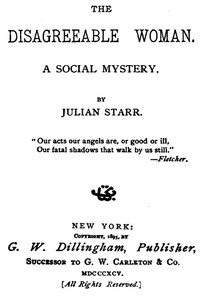
Before opening The Disagreeable Woman: A Social Mystery — Text and Context, the edition data offers a quick orientation: 26,861 words, 1 hr 57 min estimated reading time, and 4 detected text sections.
The text analysis averages about 10.8 words per sentence, while the detected sections provide another way to judge how the source is divided.
Project Gutenberg metadata also associates the work with “New York (N.Y.) -- Fiction,” connecting these edition facts with the source record’s subject description.
Explore this collection
These alternatives are selected using recorded categories and estimated reading time.
About 118 minutes
Historical Psychological Social Fiction
26,967 recorded words. 1 minutes difference from this book's estimate.
View Gutenberg source #57644About 128 minutes
Historical Psychological Social Fiction
29,219 recorded words. 11 minutes difference from this book's estimate.
View Gutenberg source #54101About 138 minutes
Historical Psychological Social Fiction
31,715 recorded words. 21 minutes difference from this book's estimate.
View Gutenberg source #54857Search stored excerpts and compare books → Choose by your preferences →
Choices use stored catalog measurements. Estimates vary with reading speed. A shared category is a catalog label, not a claim that two books have the same argument or literary quality.
Search reads excerpt text stored with this catalog and links to its associated Gutenberg record. The connection is stored in the site database; this tool does not recheck that every excerpt is word-for-word identical to that external record. Excerpt search does not cover every chapter and does not verify historical publication dates.
Catalog snapshot checked: 2026-09-25. Coverage: 97 public books, 97 available source excerpts.
Read the complete public-domain text at its original source.
Read on Project GutenbergThe story opens at a boarding-house table where a young widow simpers about her age and is met with the flat reply, “You look much older,” from a woman who will become known as the Disagreeable Woman. The narrator, a newly arrived doctor, records this exchange with a mix of curiosity and amusement, noting the general silence that follows. The woman’s calm refusal to disclose her own age—she says only that she has “reached the age of discretion”—establishes a pattern of deflected intimacy that runs through the early chapters. The doctor’s voice is observant but not judgmental, and his position as a newcomer allows him to register the boarding-house dynamics without being fully drawn into them.
The boarding-house setting provides a stage for social friction. The Disagreeable Woman’s bluntness is not mere rudeness; it punctures the pretenses of characters like Mrs. Wyman, who claims to be twenty-nine while looking older. The narrator notes that “all bent forward to listen” when the woman seems about to reveal her age, only to be disappointed. This moment captures the group’s fascination with her opacity. The doctor’s own curiosity is tempered by professional detachment—he is there to observe, not to judge. The boarding-house becomes a laboratory for studying how people react to honesty in a society that prizes polite fiction.
When the doctor visits the poor Mills family, the narrative shifts from drawing-room comedy to something more somber. He examines Alice, a pale shop-girl who has collapsed from overwork, and prescribes rest rather than medicine. The mother’s lament—“It is a hard thing to be poor, doctor”—is met with the doctor’s admission that he too struggles financially. This parallel between the doctor’s own precarious position and the family’s desperation grounds the story in economic reality. The boy Frank’s trust—“you look like a kind gentleman”—moves the doctor to act, and the scene ends with a promise of help that contrasts sharply with the boarding-house’s verbal sparring.
The narrative alternates between brisk social exchanges and slower, more reflective passages. The opening chapter moves quickly, with sharp dialogue and a comic rhythm. Later, when the doctor tends to Alice, the prose becomes more deliberate, lingering on details of the tenement: the “dirty hall,” the three flights of stairs, the “poor house situated on one of the side streets.” This change in pace mirrors the doctor’s shifting attention—from the surface of social life to the hidden struggles beneath. The Disagreeable Woman herself remains a mystery, glimpsed only in fragments, and the story’s title promises that her role will eventually be clarified.
Readers should attend to how the doctor’s narrative voice registers both the comedy and the pathos of his double life. The boarding-house scenes and the Mills family episodes are not yet connected, but the story’s structure suggests they will converge. The Disagreeable Woman’s function may be more than that of a social irritant; her silence about her past invites speculation. The book rewards attention to small gestures—a look, a pause—that hint at the larger design.
Some boarders never see the heart beneath the blunt tongue, as with that New York doctor and his sharp companion. Yet her quiet charity lingers, much like the uncertain years when a young woman returns from college, carrying new thoughts into old rooms. Reading When she came home from college — A Closer Reading, I felt that same hushed tension between what is said and what is softly done.
Your answers remain private and are stored only in this browser.