About 244 minutes
The Love of Monsieur — Context and Discussion
Historical Psychological Social Fiction
55,913 recorded words. 8 minutes difference from this book's estimate.
View Gutenberg source #51468
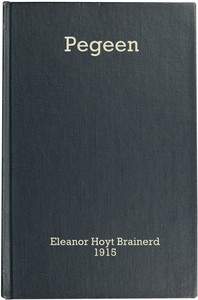
For Pegeen — Story, Setting & Ideas, the stored edition analysis reports 57,743 words, 4 hr 12 min estimated reading time, and 6 detected text sections.
The text analysis averages about 16.1 words per sentence, while the detected sections provide another way to judge how the source is divided.
Project Gutenberg metadata also associates the work with “New England -- Fiction,” connecting these edition facts with the source record’s subject description.
Explore this collection
These alternatives are selected using recorded categories and estimated reading time.
About 244 minutes
Historical Psychological Social Fiction
55,913 recorded words. 8 minutes difference from this book's estimate.
View Gutenberg source #51468About 264 minutes
Historical Psychological Social Fiction
60,502 recorded words. 12 minutes difference from this book's estimate.
View Gutenberg source #54504About 232 minutes
Historical Psychological Social Fiction
53,306 recorded words. 20 minutes difference from this book's estimate.
View Gutenberg source #51644Search stored excerpts and compare books → Choose by your preferences →
Choices use stored catalog measurements. Estimates vary with reading speed. A shared category is a catalog label, not a claim that two books have the same argument or literary quality.
Search reads excerpt text stored with this catalog and links to its associated Gutenberg record. The connection is stored in the site database; this tool does not recheck that every excerpt is word-for-word identical to that external record. Excerpt search does not cover every chapter and does not verify historical publication dates.
Catalog snapshot checked: 2026-09-25. Coverage: 97 public books, 97 available source excerpts.
Read the complete public-domain text at its original source.
Read on Project GutenbergThe novel opens with a striking encounter: a "Very Small Person" named Pegeen O'Neill announces herself at the door of John Archibald, a painter who has retreated to a rural shack. She has come to clean his kitchen, bringing her own rags and a tone of brisk authority that leaves the artist flummoxed. The scene establishes Pegeen's voice—direct, practical, and utterly serious—and Archibald's bemused helplessness. The narrative quickly reveals that Archibald fled New York and a woman named Nadine Ransome, seeking solitude. But Pegeen's arrival upends that plan, setting the stage for a story driven by the interplay between a weary adult and a determined child.
From her first line, Pegeen speaks with an efficiency that belies her age. She announces, "I’ll begin in the kitchen. They say it’s a sight," and proceeds to take charge. Her language is colloquial and assured: "Men never have such things around. They’re the wastingest creatures." She does not ask permission; she informs. This pattern continues throughout the excerpts. When Archibald offers a riding lesson, she responds with excitement but also a characteristic observation: "I always forget to be afraid of things till afterwards." Her voice is the engine of the narrative, shaping events through her perceptions.
Archibald has "run away from New York—and from Nadine Ransome," seeking a place where "June was busy with a wonderful outdoor world." The shack and its surroundings—a meadow, a valley, a wood—are described as a refuge for his "fagged brain and struggling heart." But the setting is not merely backdrop; it becomes a character through Pegeen’s interactions. She brings the outside world in, introducing neighbors, animals, and a sense of community. The horses that arrive later are treated as "additional members of the shack family," and Pegeen anthropomorphizes them, imagining their "city airs" and farm prejudices. The rural landscape is a space of recovery and connection.
Pegeen’s concept of "neighboring" is central. She contrasts Archibald’s natural friendliness with the wealthy Mr. Meredith, who "couldn’t neighbor the way you do, no matter how hard he tried." For Pegeen, true neighborliness is not about money but about being friends. She observes that rich people "want to be kind to poor folks, but they don’t know how." This theme extends to her care for animals and her gossip about Miss Moran and Mr. Meredith, whom she describes with shrewd detail: "He’s lots older than she is—only I don’t believe he’s as old as his hair is." The excerpts suggest a web of relationships that Pegeen navigates with intuitive social intelligence.
The exchanges between Pegeen and Archibald are laced with dry humor. When Archibald protests that he does have rags, he adds, "only I’m usually wearing them." Pegeen’s response—"Never mind. I’ll keep you mended up now"—turns his joke into a literal promise. Later, when Archibald asks if she is afraid of the horse, she says her throat is "all shirred up in puckers," a vivid, domestic image. The humor arises from the contrast between her childlike vocabulary and her adult-like competence. These moments lighten the narrative while revealing character: Archibald’s self-deprecation and Pegeen’s earnestness.
Readers should attend to how Pegeen’s perspective shapes the story. Her observations often carry more weight than the narrator’s descriptions. The excerpts leave many questions open—about Nadine Ransome, about Mr. Meredith’s role, about the fate of the shack—but the core dynamic is clear: a child’s unselfconscious authority gradually reorders an adult’s world. The novel rewards attention to the small, telling details in dialogue and the quiet shifts in Archibald’s responses.
Pegeen’s quiet insistence on making a home in that painter’s emptiness reminded me of how some stories stay folded inside you, like a note you can’t throw away. There’s a similar weight in A Gray Eye or So. In Three Volumes—Volume III — A Reader’s Guide, where noticing feels like its own silent language. I keep thinking about both of them. They don’t hurry.
A brief reflection can help important ideas stay with you longer.