About 781 minutes
Neighbours on the Green — A Reader’s Guide
Historical Psychological Social Fiction
179,532 recorded words. 31 minutes difference from this book's estimate.
View Gutenberg source #54106
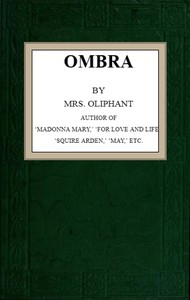
This digital edition of Ombra — A Reader’s Guide is described by source-level measurements including 172,362 words, 12 hr 30 min estimated reading time, and 15 detected text sections.
The text analysis averages about 17.1 words per sentence, while the detected sections provide another way to judge how the source is divided.
Project Gutenberg metadata also associates the work with “England -- Social life and customs -- 19th century -- Fiction,” connecting these edition facts with the source record’s subject description.
Explore this collection
These alternatives are selected using recorded categories and estimated reading time.
About 781 minutes
Historical Psychological Social Fiction
179,532 recorded words. 31 minutes difference from this book's estimate.
View Gutenberg source #54106About 682 minutes
Historical Psychological Social Fiction
156,672 recorded words. 68 minutes difference from this book's estimate.
View Gutenberg source #59138About 850 minutes
Historical Psychological Social Fiction
195,318 recorded words. 100 minutes difference from this book's estimate.
View Gutenberg source #59144Search stored excerpts and compare books → Choose by your preferences →
Choices use stored catalog measurements. Estimates vary with reading speed. A shared category is a catalog label, not a claim that two books have the same argument or literary quality.
Search reads excerpt text stored with this catalog and links to its associated Gutenberg record. The connection is stored in the site database; this tool does not recheck that every excerpt is word-for-word identical to that external record. Excerpt search does not cover every chapter and does not verify historical publication dates.
Catalog snapshot checked: 2026-09-25. Coverage: 97 public books, 97 available source excerpts.
Read the complete public-domain text at its original source.
Read on Project GutenbergMrs. Oliphant's Ombra opens with a striking image of isolation: Katherine Courtenay, an only child and heiress, grows up in 'the immense desolate house' of Langton-Courtenay, surrounded by servants but lacking the intimate family circle that shapes most childhoods. The novel immediately establishes a pattern of spatial and emotional contrasts—between the vast, empty house and the crowded social scenes that follow, between the sunlit confidence of Kate and the shadowy self-doubt of her cousin Ombra. The epigraph, a dialogue from 'The Two Poor Maidens,' introduces the central metaphor: life as 'foam, frost, and dew,' and the 'gossamer threads' that weave virgins' lives. This editorial note examines how Oliphant structures the narrative through recurring images of light and shadow, and how the movement between private and public spaces mirrors the characters' inner conflicts.
The title Ombra—Italian for 'shadow'—announces the novel's governing binary. Oliphant does not treat light and shadow as mere atmospheric effects but as structural poles around which character and plot revolve. In the excerpt, Ombra describes herself as 'a shadow' beside Kate's 'sunshine,' and Kate playfully threatens to 'plunge' a dagger into Ombra's 'treacherous heart.' The language of brightness and darkness recurs in dialogue and narration: Kate is 'so bright, so fresh,' while Ombra feels 'dull and heavy.' This opposition is not static; it shifts as the narrative progresses. The reader is invited to watch how the shadowy cousin, initially self-effacing, becomes increasingly consumed by jealousy—a feeling Oliphant calls 'an imaginary wrong' that 'cuts like a real injury.' The imagery thus serves both to define character and to foreshadow conflict.
The novel's structure alternates between confined, introspective spaces and expansive social gatherings. The opening chapters dwell in the 'immense desolate house' of Langton-Courtenay, where Kate's only companions are servants and a distrustful guardian. Later, the scene shifts to the anticipation of a ball—a public event that promises contact and competition. This movement from solitude to society is not merely a change of setting; it triggers the novel's central psychological drama. In the ballroom, Ombra's insecurity intensifies as she compares herself to Kate. Oliphant uses the transition to expose the characters' inner lives: Kate's 'dancing eyes' and laughter contrast with Ombra's 'serious' and 'frightened' tone. The ball becomes a stage where the shadow metaphor plays out in real time, as Ombra fears being 'always first' in others' affections while she remains 'only second.'
Oliphant devotes considerable attention to the psychology of jealousy, treating it not as a simple emotion but as a corrosive process. In the excerpt, Ombra reflects that 'nothing cuts like an imaginary wrong' and that the sufferer 'would pardon a real injury a hundred times while nursing and brooding over the supposed one.' This insight is embedded in the narrative voice, which shifts between Ombra's internal monologue and the narrator's commentary. The author traces how jealousy feeds on itself: Ombra 'hated herself, she was ashamed, disgusted, revolted' by her own feelings, yet she 'tried and tried, but got no better.' The novel thus offers a sustained examination of how envy distorts perception and isolates the sufferer. The reader is positioned to observe the gap between Kate's genuine affection and Ombra's suspicion, a gap that widens as the story unfolds.
Oliphant weaves several verbal and thematic motifs through the excerpts. The word 'shadow' appears in the title and in Ombra's self-description; 'sunshine' is Kate's epithet. The epigraph's 'foam, frost, and dew' echoes in the novel's preoccupation with ephemeral beauty and fragile relationships. Another recurring detail is the gesture of physical affection: Kate throws 'her caressing arm round her cousin's waist' and kisses her, while Ombra's responses are more restrained, marked by 'effort.' These small actions accumulate meaning, suggesting the asymmetry in their bond. The novel also returns to the idea of being 'first' or 'second' in love and attention—a ranking that haunts Ombra. By tracking such repetitions, the reader can appreciate how Oliphant builds a dense web of imagery and behavior that gives the novel its psychological depth.
Readers approaching Ombra will find a narrative that rewards attention to its structural symmetries and verbal echoes. The movement between shadow and light, solitude and society, is not decorative but integral to the novel's exploration of jealousy and self-knowledge. Oliphant's prose, precise and psychologically acute, invites the reader to trace how a single metaphor—the shadow—can govern an entire work. As the story unfolds, the initial contrast between Kate and Ombra may prove more complex than it first appears, and the 'gossamer threads' of the epigraph may bind the characters in unexpected ways.
I think often of how Ombra shadows its own light, jealousy eating quietly at the heart. There is a kinship there with that other guide, the one where a mummy waits, patient and silent. Both books know that what we bury inside can outlast us. The Living Mummy — A Reader’s Guide holds that same hush, that long, unblinking attention to what stirs beneath stillness. A dear pair, those two.
Your answers remain private and are stored only in this browser.