About 497 minutes
The Luck of the Vails: A Novel — Reading Companion
Historical Psychological Social Fiction
114,107 recorded words. 5 minutes difference from this book's estimate.
View Gutenberg source #57690
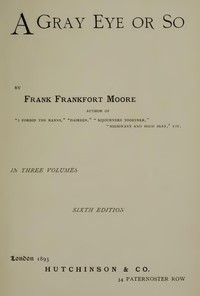
The source record for A Gray Eye or So. In Three Volumes—Volume I, II and III: Complete — Text and Context measures this digital text at 113,053 words, 8 hr 12 min estimated reading time, and 15 detected text sections.
The text analysis averages about 17.0 words per sentence, while the detected sections provide another way to judge how the source is divided.
Project Gutenberg metadata also associates the work with “Mate selection -- Fiction,” connecting these edition facts with the source record’s subject description.
Explore this collection
These alternatives are selected using recorded categories and estimated reading time.
About 497 minutes
Historical Psychological Social Fiction
114,107 recorded words. 5 minutes difference from this book's estimate.
View Gutenberg source #57690About 483 minutes
Historical Psychological Social Fiction
110,953 recorded words. 9 minutes difference from this book's estimate.
View Gutenberg source #49772About 513 minutes
Historical Psychological Social Fiction
117,906 recorded words. 21 minutes difference from this book's estimate.
View Gutenberg source #60324Search stored excerpts and compare books → Choose by your preferences →
Choices use stored catalog measurements. Estimates vary with reading speed. A shared category is a catalog label, not a claim that two books have the same argument or literary quality.
Search reads excerpt text stored with this catalog and links to its associated Gutenberg record. The connection is stored in the site database; this tool does not recheck that every excerpt is word-for-word identical to that external record. Excerpt search does not cover every chapter and does not verify historical publication dates.
Catalog snapshot checked: 2026-09-25. Coverage: 97 public books, 97 available source excerpts.
Read the complete public-domain text at its original source.
Read on Project GutenbergFrank Frankfort Moore's A Gray Eye or So opens with a conversation about 'woman in the abstract,' immediately establishing the novel's habit of framing personal and social conflicts through philosophical chapter headings. Each of the fifty-seven chapters begins with 'On...'—'On Certain Abstractions,' 'On Honesty and the Working Man,' 'On the Influence of an Ocean'—signaling that the narrative will treat courtship, politics, and morality as subjects for debate. The story moves between London clubs, Irish country houses, and the Atlantic crossing, with a recurring attention to the visual: the 'gray eye' of the title, the clashing furniture in Archie Brown's rooms, and the shifting light of moon and ocean.
The novel's chapter titles are not merely descriptive but argumentative: each begins with 'On,' as if the chapter were a treatise or a parliamentary speech. 'On Honesty and the Working Man,' 'On the Advantages of a Full Moon,' 'On the Helplessness of Woman'—these headings promise a thesis, yet the narrative often undercuts or complicates the promised argument. The effect is ironic: the reader expects a lecture and gets a scene of flirtation or a political wrangle. This structure suggests that Moore is less interested in delivering conclusions than in staging the clash of perspectives. The titles also create a rhythm of expectation, making the novel feel like a series of set-pieces or dialogues rather than a continuous plot.
Archie Brown's sitting-room is described in extraordinary detail: a Louis XV cabinet holds Sèvres porcelain and briar-root pipes; a carved ivory chair supports a soda-water bottle; a Rembrandt bought for forty shillings hangs near a Tottenham armchair. The narrator notes that 'as a panorama of styles the sitting-room would have been worth much to a lecturer on the progress or decadence of art.' This inventory does more than establish Archie's wealth—it reveals his anxiety about taste and his desire to impress. The room becomes a stage where social performance and genuine aesthetic pleasure collide. Moore uses the furniture to comment on the period's commodification of art and the difficulty of distinguishing genuine refinement from mere acquisition.
The title's 'gray eye' appears as a motif, though the excerpts do not reveal its full significance. More prominent in the provided text is the metaphor of the 'Tree of Knowledge of Good and Evil.' Archie Brown, we are told, 'bought his knowledge of good and evil fresh'—he pays for experience rather than accepting secondhand wisdom. The image recurs when Harold offers Archie 'vegetarian banquets of the canned fruit of the Tree of Knowledge,' suggesting that his advice is a diluted, safe version of real knowledge. This recurring metaphor ties the novel's interest in courtship and politics to a larger question: how do people learn about the world, and what price are they willing to pay for that education?
The novel's geography shifts between urban and rural settings, though the excerpts only hint at this. Chapter titles such as 'On a Perilous Causeway,' 'On an Irish Dance,' and 'On the Atlantic' indicate that the action moves from London clubs to Irish estates and across the ocean. The Atlantic itself becomes a character in 'On the Influence of an Ocean' and 'On the Atlantic.' This movement is not merely scenic: it allows Moore to contrast English social codes with Irish customs, and to use the voyage as a space for reflection or crisis. The reader should attend to how each setting—the club, the drawing-room, the causeway, the ship—shapes the characters' behavior and the novel's tone.
Moore's novel rewards attention to its structural quirks: the essay-like chapter headings, the ironic narrative voice, and the careful placement of objects and landscapes. Readers may find it useful to track how each 'On...' chapter delivers—or fails to deliver—on its announced topic, and to note how the gray eye and the Tree of Knowledge reappear across volumes. The novel is less a straightforward romance than a satirical examination of how people justify their choices in love, politics, and taste.
Sometimes I think about those 'On' chapters in Frankfort Moore's old three-volume set, the way they circled honesty and politics without ever landing anywhere solid. That same wandering, questioning spirit seems alive in The Thirteen Travellers — Themes and Context, where the journeys feel less like escapes and more like quiet searches. It reminds me of sitting in that furnished room, watching the gray eye gleam.
Create a short personal record of your experience with this book.