About 432 minutes
Riceyman Steps: A Novel — A Reader’s Guide
Historical Psychological Social Fiction
99,298 recorded words. 0 minutes difference from this book's estimate.
View Gutenberg source #58666
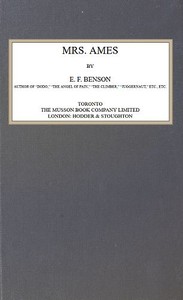
Mrs. Ames — Context and Discussion can be approached with a clearer sense of reading commitment from its source measurements: 99,225 words, 7 hr 12 min estimated reading time, and 9 detected text sections.
The text analysis averages about 17.4 words per sentence, while the detected sections provide another way to judge how the source is divided.
Project Gutenberg metadata also associates the work with “Married people -- Fiction,” connecting these edition facts with the source record’s subject description.
Explore this collection
These alternatives are selected using recorded categories and estimated reading time.
About 432 minutes
Historical Psychological Social Fiction
99,298 recorded words. 0 minutes difference from this book's estimate.
View Gutenberg source #58666About 420 minutes
Historical Psychological Social Fiction
96,434 recorded words. 12 minutes difference from this book's estimate.
View Gutenberg source #50895About 419 minutes
Historical Psychological Social Fiction
96,362 recorded words. 13 minutes difference from this book's estimate.
View Gutenberg source #50317Search stored excerpts and compare books → Choose by your preferences →
Choices use stored catalog measurements. Estimates vary with reading speed. A shared category is a catalog label, not a claim that two books have the same argument or literary quality.
Search reads excerpt text stored with this catalog and links to its associated Gutenberg record. The connection is stored in the site database; this tool does not recheck that every excerpt is word-for-word identical to that external record. Excerpt search does not cover every chapter and does not verify historical publication dates.
Catalog snapshot checked: 2026-09-25. Coverage: 97 public books, 97 available source excerpts.
Read the complete public-domain text at its original source.
Read on Project GutenbergFrom its first sentence, Mrs. Ames anchors itself in the material world: a breakfast tongue of disappointing colour and flavour becomes the catalyst for Mrs. Altham's morning errand, while her husband sets off for the club. Benson immediately establishes a symmetrical social choreography—husbands to the smoking-room, wives to the High Street—that structures the daily life of Riseborough. The narrative eye lingers on objects (the glass receptacle, the gilt paper moulting from a sandal-strap, a strawberry-ice stain on a costume) as indices of unspoken dissatisfaction. These details are not merely decorative; they carry emotional weight. Mrs. Ames's Cleopatra costume, with its peeling gilt and disfiguring spot, mirrors her own sense of being 'vaguely ungilded and disfigured.' The novel's movement between domestic interiors, garden, and club creates a rhythm of public performance and private reflection.
The opening chapter establishes a precise social geography. Mr. Altham strolls to the club in Queensgate Street; Mrs. Altham proceeds to the High Street to complain about the tongue. Benson notes that 'on every day of the week except Sunday, there was some equally compelling cause' for these expeditions. This parallel movement is not incidental—it is the novel's structural backbone. The club and the High Street function as twin arenas for the exchange of news and the maintenance of reputation. The narrative repeatedly cuts between these spaces, creating a stereoscopic view of Riseborough's social life. The dogs chained outside the club—'in various states of boredom and irritation'—offer a wry commentary on the human routines they mirror. This pattern of symmetrical errands recurs throughout the excerpts, suggesting that the novel's architecture is built on the rhythm of departures and returns, of public appearances and private disappointments.
Major Ames's morning exertions in the garden—pulling the roller—are described with a curious blend of physicality and metaphor. The roller is said to be good for 'squashing worms and unprofitable reflections.' Yet the metaphor of the boat, introduced in his night-time thoughts, persists: 'his boat, so to speak, had not been drawn up safely ashore, but was still in the midst of accelerating waters.' This image of a boat caught in a current recurs, linking physical labor to emotional drift. The garden, a space of ordered cultivation, becomes a site of internal disorder. Major Ames's sweat—'the honest dews of toil'—contrasts with the 'extraordinary little whirrings and racings of wheels' he feels inside. The garden roller, a heavy, repetitive tool, is set against the delicate, invasive 'finger' of Mrs. Evans, who 'was prodding about among the internal wheels and springs of his mechanism.' The novel uses such mechanical and nautical imagery to render psychological states concrete.
Mrs. Ames's Cleopatra costume, laid out on the sofa in her bedroom, is described with forensic attention: 'The gilt paper had moulted off one of the sandal-straps, a spilt dropping of strawberry-ice made a disfiguring spot on the tunic of Arab shawl.' The costume's decay parallels her own sense of age and grievance. Benson extends this to her views on smoking: she had 'often said in the most liberal manner that she did not think it wicked of women to smoke, but only horrid.' Now she feels 'disposed to consider anybody else horrid, and—and possibly wicked.' The costume, the cigarette, the strong tea—all are props in a performance of composure that is visibly fraying. The novel repeatedly uses clothing and domestic objects as indices of emotional state. Mrs. Ames's discontent is not stated directly but emerges through the disarray of her costume and the sharpness of her thoughts. This attention to the material surface—the gilt, the stain, the teapot—creates a texture of suppressed feeling.
The novel's social world is defined by the exchange of information. In the club smoking-room, Mr. Altham meets General Fortescue, Mr. Brodie, and Major Ames; in the High Street, Mrs. Altham encounters their wives. Benson emphasizes the simultaneity of these exchanges: 'Thus, if any striking events had taken place since the previous afternoon, they all learned about them.' The narrative moves between these spaces, creating a sense of a community that knows itself through gossip. The club is a space of male sociability, the High Street of female errands, but both are governed by the same logic of surveillance and report. The dogs outside the club—bored and irritated—suggest the tedium underlying these rituals. The novel's structure, with its repeated departures and returns, mirrors the circularity of gossip: news circulates, is digested, and recirculates. This social geometry is not merely background; it is the engine of the plot, as private feelings become public knowledge through the network of morning errands.
Readers attentive to the novel's recurring images—the garden roller, the boat, the moulting costume—will find a work that uses the material world to chart inner lives. The symmetry of morning errands, the club and the High Street as parallel stages, and the tension between public performance and private discontent are woven into the narrative's fabric. Approach Mrs. Ames as a study in the poetics of routine, where the smallest object—a tongue, a sandal-strap, a cigarette—carries the weight of unspoken emotion.
The rain tapped against the window as I turned the last page of Mrs. Ames, lingering on that final image of tongues silenced. Then, almost by accident, my hand drifted to a shelf and pulled down The Living Mummy — A Reader’s Guide. Odd, how both books wrap their secrets in linen, waiting for someone patient enough to unfold them.
Use these questions to collect your thoughts before moving on.