About 335 minutes
The Charing Cross Mystery — Text and Context
Historical Psychological Social Fiction
76,984 recorded words. 0 minutes difference from this book's estimate.
View Gutenberg source #59893
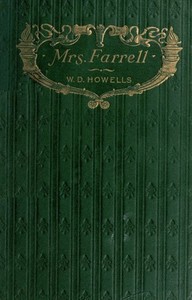
The catalog record for Mrs. Farrell — Inside the Classic provides practical reading context through 76,932 words, 5 hr 35 min estimated reading time, and 7 detected text sections.
The text analysis averages about 16.7 words per sentence, while the detected sections provide another way to judge how the source is divided.
Project Gutenberg metadata also associates the work with “Widows -- Fiction,” connecting these edition facts with the source record’s subject description.
Explore this collection
These alternatives are selected using recorded categories and estimated reading time.
About 335 minutes
Historical Psychological Social Fiction
76,984 recorded words. 0 minutes difference from this book's estimate.
View Gutenberg source #59893About 336 minutes
Historical Psychological Social Fiction
77,196 recorded words. 1 minutes difference from this book's estimate.
View Gutenberg source #54212About 334 minutes
Historical Psychological Social Fiction
76,740 recorded words. 1 minutes difference from this book's estimate.
View Gutenberg source #58202Search stored excerpts and compare books → Choose by your preferences →
Choices use stored catalog measurements. Estimates vary with reading speed. A shared category is a catalog label, not a claim that two books have the same argument or literary quality.
Search reads excerpt text stored with this catalog and links to its associated Gutenberg record. The connection is stored in the site database; this tool does not recheck that every excerpt is word-for-word identical to that external record. Excerpt search does not cover every chapter and does not verify historical publication dates.
Catalog snapshot checked: 2026-09-25. Coverage: 97 public books, 97 available source excerpts.
Read the complete public-domain text at its original source.
Read on Project GutenbergWilliam Dean Howells's Mrs. Farrell (first serialized as Private Theatricals in 1875) opens with a title that signals both a character and a social role. The excerpts reveal a narrative voice that oscillates between close psychological observation and brisk dialogue, creating a rhythm that mirrors the tensions among a small group at a New England boardinghouse. Howells uses the widow Mrs. Farrell as a catalyst for emotional maneuvering, and the language shifts from formal politeness to sharp, almost theatrical exchanges.
The excerpts show Howells employing dialogue not merely to advance plot but to expose power dynamics. In one exchange, Mrs. Farrell chides Easton for his scruples: “Why, if such a man as that had liked me, and I had offended him, there isn’t anyone I wouldn’t sacrifice.” Her speech is rapid, imperative, and laced with rhetorical questions, while Easton’s replies are hesitant and self-conscious. The contrast in pace—her volley of words against his pauses—creates a sense of unequal footing. Howells also uses stage directions within the prose: “she bent down her face and peered into his with a sidelong, mock-serious glance.” These gestures, embedded in the dialogue, heighten the theatrical quality that the original serial title promised.
Howells’s narrator moves between intimate access to characters’ thoughts and a more detached, observational stance. When Easton falls into a “somber reverie,” the narrator notes that “for the wretched moment he forgot her presence,” offering a window into his absorption. Yet elsewhere, the narrator steps back to comment on Mrs. Farrell’s motives: “A light of triumph burned in her dark eyes, but one could not have said that as a woman she had not a right.” This parenthetical judgment introduces a moral ambiguity, as the narrator both justifies and questions her behavior. The shifts in narrative distance—from close interiority to editorial aside—create a fluctuating pace that keeps the reader uncertain whether to sympathize or critique.
The excerpts demonstrate Howells’s control of tempo through emotional escalation. A scene that begins with Easton’s “sigh of torment” and Mrs. Farrell’s mock-serious banter quickly accelerates into a confrontation: “No!” said Easton, so fiercely that Mrs. Farrell started with a sudden shock of panic.” The abrupt shift from teasing to anger compresses the emotional arc into a few lines. Howells then decelerates with a descriptive passage: “they moved on through the hollow, and came from its gloom at last upon the open meadow.” This alternation between tense dialogue and expansive landscape description gives the prose a breathing rhythm, preventing the emotional pitch from becoming monotonous.
Readers attentive to Howells’s craft will notice how the language of Mrs. Farrell enacts the very “private theatricals” of its title. The novel’s voice—alternately intimate and judgmental—and its variable pacing reward close attention to the interplay of speech, gesture, and narrative commentary. These elements, glimpsed in the excerpts, suggest a work that uses social friction to explore character rather than plot.
I keep thinking about Howells’s unhurried pauses in Mrs. Farrell, how the prose lingers where a feeling must settle. It reminded me of another afternoon, turning pages of The Little House — Reading Notes, where those quiet, interrupted sentences felt similarly alive—less a story than a held breath. There is something tender in that slowness, like remembering a room long after leaving it.
Capture what you thought, learned, and would like to remember.