About 576 minutes
The Coil of Carne — Context and Discussion
Fairy Tales Myths Imaginary Worlds
132,349 recorded words. 73 minutes difference from this book's estimate.
View Gutenberg source #53819
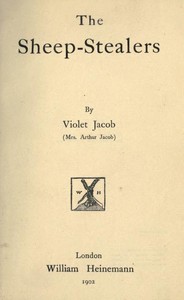
The source record for The Sheep-Stealers — A Reader’s Guide measures this digital text at 115,476 words, 8 hr 23 min estimated reading time, and 39 detected text sections.
The text analysis averages about 18.9 words per sentence, while the detected sections provide another way to judge how the source is divided.
Project Gutenberg metadata also associates the work with “Country life -- Fiction,” connecting these edition facts with the source record’s subject description.
Explore this collection
These alternatives are selected using recorded categories and estimated reading time.
About 576 minutes
Fairy Tales Myths Imaginary Worlds
132,349 recorded words. 73 minutes difference from this book's estimate.
View Gutenberg source #53819About 613 minutes
Fairy Tales Myths Imaginary Worlds
140,890 recorded words. 110 minutes difference from this book's estimate.
View Gutenberg source #48883About 319 minutes
Fairy Tales Myths Imaginary Worlds
73,175 recorded words. 184 minutes difference from this book's estimate.
View Gutenberg source #56902Search stored excerpts and compare books → Choose by your preferences →
Choices use stored catalog measurements. Estimates vary with reading speed. A shared category is a catalog label, not a claim that two books have the same argument or literary quality.
Search reads excerpt text stored with this catalog and links to its associated Gutenberg record. The connection is stored in the site database; this tool does not recheck that every excerpt is word-for-word identical to that external record. Excerpt search does not cover every chapter and does not verify historical publication dates.
Catalog snapshot checked: 2026-09-25. Coverage: 97 public books, 97 available source excerpts.
Read the complete public-domain text at its original source.
Read on Project GutenbergThe novel opens with a precise geographical contrast: the Black Mountain rises like an 'awakening giant' above the Wye valley, while a 'band of country totally unlike either' forms an intermediate stage between wild summit and fertile lowlands. This layered setting mirrors the social divisions that drive the story—the 'Two Communities' of the first chapter are not just rich and poor, but also English and Welsh, settled and itinerant. The Rebecca Riots, a historical series of protests against toll gates and rural injustice, provide the backdrop, but Jacob focuses on personal conflicts: a man named George, caught between desperation and pride, and Mrs. Walters, a wealthy widow whose 'inverted vanity' masks a controlling nature. Their encounter at a chapel, where she offers work but he retrieves his bill-hook rather than pray, sets up a pattern of missed connections and unspoken tensions.
The opening pages establish the Black Mountain as more than scenery. Jacob describes the 'desolate grandeur of the Twmpa' and the 'somewhat oppressive luxuriance' of the river valley, with the intermediate band of country forming a 'kind of intermediate stage.' This three-tiered geography echoes the novel's social structure: the gentry at Waterchurch, the farming community, and the landless poor like George. The mountain itself is a constant presence, 'raising itself like an awakening giant'—a reminder of forces beyond human control. When Mrs. Walters drives her cart 'in an immense circle on the short grass,' the detail suggests a woman accustomed to dominating space, yet her movements are also constrained by the landscape's uneven hollows.
Mrs. Walters's 'touch of what might be called inverted vanity' reveals a character who performs humility while enjoying her status. Her offer of work to George is laced with moral judgment: she hopes her words have 'moved him to pray,' but he only retrieves his bill-hook. The chapel setting—a place of supposed equality—becomes a stage for class negotiation. Later, the Vicar of Crishowell, who has a 'secret strain of romance,' contrasts with the Squire, a 'figure-head' devoted to field sports. Jacob uses these religious and social figures to question whether piety is genuine or a mask for self-interest. The Archaeological Society meetings, where antiquities are discussed, suggest a search for meaning in the past that the present cannot provide.
Small physical details carry emotional weight. George's bill-hook, left 'lying on the ground in the bottom o' the seat,' is a tool of his trade but also a symbol of his independence—he will not abandon it even for a job. Mrs. Walters's dress is 'brushed where the wheel had rubbed it,' a mark of her journey's grime that she cannot entirely erase. The cart 'disappearing up the lane' with the two women's 'backs shaking' as wheels hit hollows suggests a precarious journey, both literal and figurative. These objects and actions—a bill-hook, a brushed dress, a shaking cart—anchor the novel's emotional conflicts in tangible, everyday reality.
Readers should attend to the way Jacob builds meaning through landscape and gesture rather than explicit statement. The Rebecca Riots, while historically significant, function here as a distant pressure rather than a central event; the real drama lies in the spaces between what characters say and do. Notice how often a character's true feelings emerge not in dialogue but in a glance, a retrieved object, or a description of the mountain's shadow.
I’ve often thought that Violet Jacob’s Welsh border folk, with their carefully hidden motives, dwell in the same quiet shadows as Craig Kennedy’s clients. Both worlds hinge on what a person refuses to say aloud. Years of shelving these volumes taught me that a secret’s weight rarely changes, only its costume. The Soul Scar: A Craig Kennedy Scientific Mystery Novel — Reading Companion feels like an old friend to that thought.
A brief reflection can help important ideas stay with you longer.