About 45 minutes
The Westminster Alice — Reading Notes
Fairy Tales Myths Imaginary Worlds
10,297 recorded words. 70 minutes difference from this book's estimate.
View Gutenberg source #58201
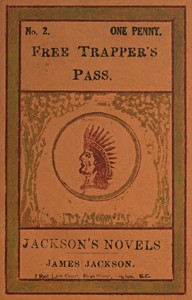
This digital edition of Free Trapper's Pass; or, the Gold-seeker's Daughter! — Context and Discussion is described by source-level measurements including 26,302 words, 1 hr 55 min estimated reading time, and 3 detected text sections.
The text analysis averages about 22.0 words per sentence, while the detected sections provide another way to judge how the source is divided.
Project Gutenberg metadata also associates the work with “Indians of North America -- Fiction,” connecting these edition facts with the source record’s subject description.
Explore this collection
These alternatives are selected using recorded categories and estimated reading time.
About 45 minutes
Fairy Tales Myths Imaginary Worlds
10,297 recorded words. 70 minutes difference from this book's estimate.
View Gutenberg source #58201About 201 minutes
Fairy Tales Myths Imaginary Worlds
46,064 recorded words. 86 minutes difference from this book's estimate.
View Gutenberg source #58937About 215 minutes
Fairy Tales Myths Imaginary Worlds
49,424 recorded words. 100 minutes difference from this book's estimate.
View Gutenberg source #55222Search stored excerpts and compare books → Choose by your preferences →
Choices use stored catalog measurements. Estimates vary with reading speed. A shared category is a catalog label, not a claim that two books have the same argument or literary quality.
Search reads excerpt text stored with this catalog and links to its associated Gutenberg record. The connection is stored in the site database; this tool does not recheck that every excerpt is word-for-word identical to that external record. Excerpt search does not cover every chapter and does not verify historical publication dates.
Catalog snapshot checked: 2026-09-25. Coverage: 97 public books, 97 available source excerpts.
Read the complete public-domain text at its original source.
Read on Project GutenbergThe story begins with a raid by a band of Blackfeet on a cabin near the Yellowstone River. The description of the cabin emphasizes its rough construction but surprising comfort, with walls smoothed by axe and plastered with clay. A fair girl with golden hair stands in the doorway, her appearance notably unmarked by the sun—a detail that sets her apart from the frontier setting. The arrival of a horseman, John Howell, is quickly followed by the attack, and the narrative shifts between the trappers' defense and the capture of Major Robison and his daughter.
The opening pages establish a series of contrasts. The cabin is described as both rough and comfortable, the girl as both out of place and resilient. The narrator notes that her cheeks bore little trace of the sun, a detail that emphasizes her incongruity in the wilderness. The trappers are portrayed as resourceful but fallible: after rescuing Major Robison, they fail to save his daughter immediately, and the text comments that "vain promises those, which are easier made than kept." This self-critical tone is unusual for the genre and suggests a narrative aware of its own conventions.
The pursuit of the captors is described with attention to practical details: the condition of the horses, the wounds of the men, and the difficulty of following a trail at night. The trappers leave the wounded Bill Stevens behind, and Major Robison takes his rifle—a weapon "to be depended upon." The narrative notes that the trail was "broad and deep" and thus easy to follow, but the fugitives remain out of sight. The passage of time is marked by the moon rising, and the pursuit continues into the night. The focus on the physical limitations of the pursuers grounds the action in a sense of realism.
The title location is introduced in Chapter IV as a spot chosen by Tom Rutter for its suitability as a retreat. The narrator states that Rutter was "well acquainted with every inch of the country" and that he judged the pass to be "a sure retreat, for the time, at least." The pass is not described in detail, but its function as a hiding place and potential trap is clear. The name itself suggests both freedom and confinement, a tension that may be explored as the story progresses. The excerpt ends before the pass is fully depicted, leaving its role ambiguous.
The excerpts reveal a narrative that balances action with reflective commentary, and that pays close attention to the physical details of the frontier. The incomplete text leaves several questions open: the fate of the captive girl, the nature of the Free Trappers' Pass, and the outcome of the pursuit. Readers should note the story's penny-novel origins and its serialized structure, which may explain the episodic pacing and the reliance on cliffhangers.
That rainy afternoon, Free Trapper’s Pass kept me turning pages, its golden-haired captive pressed against the wilderness. Later, restless, I found myself drifting toward a different sort of frontier—one of weathered barns and quiet grudges in The Sheep-Stealers — A Reader’s Guide. Both landscapes hold people shaped by hard ground, and that felt enough.
Create a short personal record of your experience with this book.