About 194 minutes
The Barton Experiment — Background and Themes
Exploration Survival Adventure Tales
44,605 recorded words. 25 minutes difference from this book's estimate.
View Gutenberg source #53031
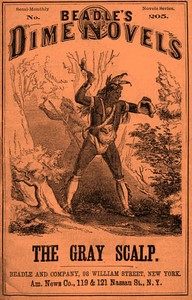
The source record for The Gray Scalp; Or, The Blackfoot Brave — Background and Themes measures this digital text at 38,747 words, 2 hr 49 min estimated reading time, and 24 detected text sections.
The text analysis averages about 17.0 words per sentence, while the detected sections provide another way to judge how the source is divided.
Project Gutenberg metadata also associates the work with “Indians of North America -- Fiction,” connecting these edition facts with the source record’s subject description.
Explore this collection
These alternatives are selected using recorded categories and estimated reading time.
About 194 minutes
Exploration Survival Adventure Tales
44,605 recorded words. 25 minutes difference from this book's estimate.
View Gutenberg source #53031About 53 minutes
Exploration Survival Adventure Tales
12,152 recorded words. 116 minutes difference from this book's estimate.
View Gutenberg source #54896About 287 minutes
Exploration Survival Adventure Tales
65,993 recorded words. 118 minutes difference from this book's estimate.
View Gutenberg source #51966Search stored excerpts and compare books → Choose by your preferences →
Choices use stored catalog measurements. Estimates vary with reading speed. A shared category is a catalog label, not a claim that two books have the same argument or literary quality.
Search reads excerpt text stored with this catalog and links to its associated Gutenberg record. The connection is stored in the site database; this tool does not recheck that every excerpt is word-for-word identical to that external record. Excerpt search does not cover every chapter and does not verify historical publication dates.
Catalog snapshot checked: 2026-09-25. Coverage: 97 public books, 97 available source excerpts.
Read the complete public-domain text at its original source.
Read on Project GutenbergThe Gray Scalp opens with a midnight attack and immediately establishes a pattern of rapid reversals. Within the first few chapters, a prairie encounter leads to a serious reverse, and the Blackfoot brave White Shield—initially a potential threat—becomes a trusted ally. The narrative voice moves briskly, compressing long journeys and emotional shifts into short paragraphs. A key early scene shows Silverspur nearly shooting White Shield out of suspicion, only to discover the Indian has endured starvation and capture on his behalf. This moment of near-tragedy, resolved by a shared meal and a pipe, encapsulates the novel's central tension: trust tested and reaffirmed under duress.
The excerpt reveals a story built on misunderstandings and narrow escapes. When Silverspur finds White Shield, his first impulse is violence: “The heart of Silverspur was hot,” he admits, having believed lies whispered by a “little bird.” White Shield, in turn, recounts a harrowing journey—captured by Arapahoes, escaping without food or weapons, surviving on roots for three days. The emotional pivot comes when Silverspur, overcome with remorse, shares his haversack and forces the starving man onto his own horse. This pattern—suspicion followed by reconciliation—recurs throughout the available text, suggesting the novel’s engine is less about external conflict than about the fragile bonds between its characters.
Published by Beadle and Company as part of their Dime Novels series, The Gray Scalp follows a formula of swift incident and moral clarity. The chapter titles telegraph the pace: “A Midnight Attack,” “A Serious Reverse,” “A Crow Victory.” The prose wastes no words on setting or introspection; instead, it moves from action to action. White Shield’s backstory—delivered as a single block of exposition—covers days of flight, capture, and escape in a few paragraphs. The novel’s structure relies on coincidences and timely revelations, such as the arrow left to mark a trail. Readers familiar with the dime novel tradition will recognize the emphasis on physical endurance, sudden reversals, and the constant threat of violence.
The Great Plains and mountain passes are not merely backdrops but active forces in the narrative. Characters cross the “South Pass,” follow the “Republican Fork of the Platte,” and navigate “the heart of the country claimed by the Arapahoes.” These geographical markers anchor the story in a recognizable frontier geography while also serving as obstacles: the pass must be defended, the trail is blind, and the village has been moved. The landscape dictates the characters’ movements and limits their options. When White Shield searches for Silverspur, he “wandered widely from the trail”; when he escapes the Arapahoes, he sets out “without food or weapons.” The environment is indifferent, and survival depends on reading its signs correctly.
Readers approaching The Gray Scalp should expect a fast-paced narrative where loyalties shift as quickly as the setting. The dime novel format rewards attention to small details—a shared pipe, a hidden arrow, a whispered lie—that drive the plot forward. The incomplete excerpts leave the fate of Flora Robinette unresolved, but the pattern of trust tested and restored suggests a resolution built on mutual reliance rather than individual heroism.
The rain drummed on the windows while I followed Silverspur and White Shield through their reversals, struck by how trust flickered and returned like a lantern. That lingering uncertainty stayed with me. Later, drying my hands, I pulled down Wanderer of the Wasteland — A Reader’s Guide almost by accident, and found the same lonely wavering between loyalty and isolation, softer but no less true.
Use these questions to collect your thoughts before moving on.