About 29 minutes
The Story of the Siren — Key Ideas to Explore
Exploration Survival Adventure Tales
6,538 recorded words. 24 minutes difference from this book's estimate.
View Gutenberg source #58581
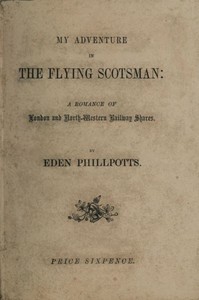
My Adventure in the Flying Scotsman; A Romance of London and North-Western Railway Shares — Themes and Context can be approached with a clearer sense of reading commitment from its source measurements: 12,152 words, 53 min estimated reading time, and 2 detected text sections.
The text analysis averages about 22.9 words per sentence, while the detected sections provide another way to judge how the source is divided.
Project Gutenberg metadata also associates the work with “Inheritance and succession -- Fiction,” connecting these edition facts with the source record’s subject description.
Explore this collection
These alternatives are selected using recorded categories and estimated reading time.
About 29 minutes
Exploration Survival Adventure Tales
6,538 recorded words. 24 minutes difference from this book's estimate.
View Gutenberg source #58581About 169 minutes
Exploration Survival Adventure Tales
38,747 recorded words. 116 minutes difference from this book's estimate.
View Gutenberg source #56175About 194 minutes
Exploration Survival Adventure Tales
44,605 recorded words. 141 minutes difference from this book's estimate.
View Gutenberg source #53031Search stored excerpts and compare books → Choose by your preferences →
Choices use stored catalog measurements. Estimates vary with reading speed. A shared category is a catalog label, not a claim that two books have the same argument or literary quality.
Search reads excerpt text stored with this catalog and links to its associated Gutenberg record. The connection is stored in the site database; this tool does not recheck that every excerpt is word-for-word identical to that external record. Excerpt search does not cover every chapter and does not verify historical publication dates.
Catalog snapshot checked: 2026-09-25. Coverage: 97 public books, 97 available source excerpts.
Read the complete public-domain text at its original source.
Read on Project GutenbergEden Phillpotts' 1888 novella opens with bank clerk John Lott trudging through a lurid November sunset, his mind burdened by a death that has upended his orderly existence. The narrator's voice—self-deprecating, meticulous, and given to quaint asides—immediately establishes a tension between mundane domesticity and extraordinary events. Lott walks from Richmond to Petersham rather than take a cab, a choice he defends with sound reasons, hinting at secrets he is not yet ready to disclose. The dying light, described in terms of 'bars of blood' and 'flaming gems,' sets a sinister tone that pervades the tale.
The story's catalyst is a 'dangerous legacy'—an inheritance from a relative whose death is sudden and startling. Lott, a small, middle-aged clerk, finds himself entangled in issues of 'honour, rectitude, and duty' that far exceed his usual concerns. The excerpts reveal a narrator who weighs moral choices with anxious precision, yet the exact nature of the inheritance and the deceased's identity remain tantalisingly vague. Phillpotts builds suspense through Lott's reluctance to explain his actions fully, leaving the reader to infer that the legacy carries a supernatural taint. The description of a phantom vision, glimpsed the preceding evening, suggests that the dead may not rest quietly.
After the theft of Lott's wealth, a detective arrives and fastens on a seemingly trivial detail: a candle left burning in the room where the thief, Walter Sorrell, had been reading. The candle's grease has guttered on one side, indicating a draught caused by an open window and door. The detective reconstructs the scene: Sorrell 'went in the devil of a hurry,' as if pursued. This forensic observation—rooted in physical evidence rather than testimony—anchors the mystery in tangible reality, even as Lott privately wonders whether a 'horrid vision' drove Sorrell to flee. The contrast between the detective's practical method and Lott's superstitious fears creates a productive tension.
The novella's title promises an adventure aboard the Flying Scotsman, yet the excerpts only hint at this journey. Lott recalls a planned trip to Scotland, which he initially wishes to avoid but later sees as a welcome distraction. The railway setting, however, is more than backdrop: the subtitle 'A Romance of London and North-Western Railway Shares' ties the plot to the speculative finance of Victorian rail expansion. The stolen leathern bag, found empty by the Thames, and the mention of shares suggest that the inheritance may have been in securities. Phillpotts weaves together the tangible world of train timetables and stock certificates with the intangible realm of ghosts and guilty consciences.
Readers approaching this short novel should attend to the interplay between Lott's homely narration and the Gothic undercurrents that threaten to break through. The detective's candle-gutter clue exemplifies how Phillpotts grounds supernatural dread in material detail. The incomplete excerpts leave the resolution of both the theft and the phantom ambiguous, inviting speculation about whether the Flying Scotsman journey will bring closure or further terror.
Reading about John Lott’s phantom-haunted flight, I found myself drifting to an old story about a Blackfoot brave, The Gray Scalp; Or, The Blackfoot Brave — Background and Themes. Both men carry a stolen inheritance—one of gold, the other of identity—and both wander through darkness that feels less like night than like a held breath. It’s a strange kinship, how terror can wear such different faces yet leave the same quiet chill.
Build a private reading journal entry for this title.