About 639 minutes
Wanderer of the Wasteland — A Reader’s Guide
Exploration Survival Adventure Tales
146,890 recorded words. 117 minutes difference from this book's estimate.
View Gutenberg source #60102
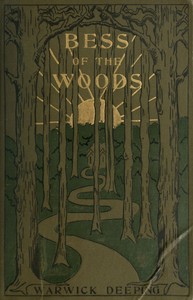
The source record for Bess of the Woods — Background and Themes measures this digital text at 119,890 words, 8 hr 42 min estimated reading time, and 15 detected text sections.
The text analysis averages about 16.1 words per sentence, while the detected sections provide another way to judge how the source is divided.
Project Gutenberg metadata also associates the work with “Mate selection -- Fiction,” connecting these edition facts with the source record’s subject description.
Explore this collection
These alternatives are selected using recorded categories and estimated reading time.
About 639 minutes
Exploration Survival Adventure Tales
146,890 recorded words. 117 minutes difference from this book's estimate.
View Gutenberg source #60102About 377 minutes
Exploration Survival Adventure Tales
86,621 recorded words. 145 minutes difference from this book's estimate.
View Gutenberg source #54921About 356 minutes
Exploration Survival Adventure Tales
81,839 recorded words. 166 minutes difference from this book's estimate.
View Gutenberg source #51919Search stored excerpts and compare books → Choose by your preferences →
Choices use stored catalog measurements. Estimates vary with reading speed. A shared category is a catalog label, not a claim that two books have the same argument or literary quality.
Search reads excerpt text stored with this catalog and links to its associated Gutenberg record. The connection is stored in the site database; this tool does not recheck that every excerpt is word-for-word identical to that external record. Excerpt search does not cover every chapter and does not verify historical publication dates.
Catalog snapshot checked: 2026-09-25. Coverage: 97 public books, 97 available source excerpts.
Read the complete public-domain text at its original source.
Read on Project GutenbergThe opening scene of Bess of the Woods establishes its world through a single, carefully composed dining-table. Warwick Deeping lets the objects—a china punch-bowl painted with green dragons, a Dutch clock striking three, a log-fire blazing on the irons—do much of the work. The men are drawn in broad, unflattering strokes: Sir Peter Hardacre, a fat aristocrat with a tuberose nose, sprawls in his chair; his son Lot wears a scarlet hunting-coat and buckskin breeches, a clay pipe drooping from his mouth. Richard Jeffray, the protagonist, stands stiff and ill at ease, bowing as though not wholly sure of his own dignity. The prose is unhurried, attentive to posture and gesture, and it signals from the first paragraph that this is a story in which social surfaces will be peeled back.
Deeping’s prose is thick with physical detail that does more than decorate. The punch-bowl is not merely a bowl but a piece of china covered with green dragons and blue mandarins; Sir Peter’s waistcoat is brocaded, his wig flows in slovenly profusion. These details are not neutral—they carry judgment. The baronet fumbles for his snuff-box and spills half its contents over his waistcoat, a small action that underscores his ungainly torpor. Later, when Richard is convalescent, the world is described as spreading itself anew before reawakened eyes, with nature’s green-clad bosom breathing softly. The contrast between the cluttered, decadent interior of Hardacre Hall and the open, vital landscape beyond is drawn not through abstract commentary but through the weight of nouns and verbs: thrust back, sprawled, abutting, flapping, snoring. The narrator’s eye is forensic, and the reader is invited to see these people as specimens.
Dialogue in these excerpts is sparse but telling. When Lot Hardacre speaks, his words are laced with a coarse familiarity: “We’re coarse devils, Dick, eh? Jil is a gentle creature, and don’t swear—at least, not often.” The wink and the patronizing tone reveal a man who performs bonhomie while belittling his sister. Sir Peter’s speech is punctuated with oaths and bluster: “Damme,” he says, “what a dull dog it is!” and later, “Gad, boy, it’s damned early.” The parson, Jessel, contributes only a snore. Richard’s own speech is formal, almost stiff: “You will pardon me, Sir Peter… the days are short, and I must be in the saddle.” The dialogue does not advance plot so much as it exposes character through rhythm and register. The narrator’s own voice, meanwhile, is wry and analytical, as when he notes that Parson Jessel’s wig was flapping forward with an unsaintly tilt.
The second excerpt shifts abruptly from the crowded dining-room to Richard’s sickroom, and the change in prose texture is marked. Where the opening was dense with objects and bodies, the convalescence passage is airy, introspective, and almost lyrical. Deeping uses the period of illness as a structural hinge: Richard, muffled in a dressing-gown, sits before an open window and looks out over the park. The narrator steps back to offer a general reflection on sickness as a season of severe self-judgment, only to undercut it: “But with Jeffray his recovery was as the coming forth of a moth from the cramping sack of custom.” The metaphor is precise and slightly unexpected. The structure of the passage—moving from the general to the particular, from orthodox piety to romantic instinct—mirrors Richard’s own mental shift. The narrator is careful to limit inference, noting that Richard’s repentance was romantic rather than religious, and that his thoughts flew feverishly toward Bess.
Throughout the excerpts, the natural world functions as a counterpoint to the artificiality of the Hardacre household. In the opening, winter sunlight floods through tall windows onto a polished floor, but the men are oblivious, sunk in drink and torpor. In the convalescence scene, Richard watches the great trees standing calm and still under blue heavens, and the green billows of the park aglisten under the sun. The narrator explicitly contrasts this with the prosaic morality of the pious, aligning Richard’s recovery with the glow of the instincts that burn on the altar of nature. Bess herself is associated with this world: she is Bess of the Woods, and Richard’s thoughts of her are described in terms of light, voice, and dusky hair. The recurring detail of windows—the tall windows of the dining-room, the open window of the sickroom—frames the opposition between inside and outside, constraint and freedom. Deeping does not overstate the symbolism; he lets the images accumulate.
Readers attentive to authorial choice will find in Bess of the Woods a novel that works through accumulation rather than declaration. Deeping’s sentences are patient, his eye for posture and property unsparing. The excerpts suggest a writer more interested in the texture of a moment than in rapid plot advancement. Approach the book as a study in contrasts—between the coarse gentry and the natural world, between social performance and private longing—and let the prose itself guide your attention.
That rainy afternoon, I lingered over Warwick Deeping’s prose, feeling the weight of Richard’s hesitation beside Bess’s wild grace. It made me think of other quiet burdens, other lives lived at the edge of expectation. Later, by lamplight, I found myself reaching for The Railway Man and His Children — Reading Companion—not for answers, just for company, the way one turns toward a familiar voice in the dark.
Create a short personal record of your experience with this book.