
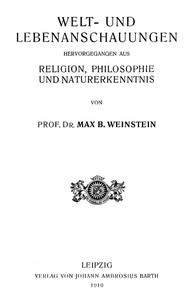
Welt- und Lebenanschauungen; hervorgegangen aus Religion, Philosophie und…
Published in 1908, Max B. Weinstein's Welt- und Lebenanschauungen (World and Life Views) is an intellectual journey. The book doesn't follow a traditional plot. Instead, Weinstein sets out to trace the origins of our most fundamental beliefs. He acts as a guide, examining how humanity has tried to answer life's biggest questions across history.
The Story
Think of it as an exploration, not a narrative. Weinstein's central idea is that our personal worldviews are a kind of synthesis. They are built from materials provided by three major sources: the faith and tradition of religion, the logic and questioning of philosophy, and the evidence-based discoveries of natural science. The book walks us through how these systems interact, conflict, and sometimes combine to shape what an individual or a society believes about reality, purpose, and morality.
Why You Should Read It
What's amazing is how current it feels. The tension Weinstein describes—between faith, reason, and science—is still the backdrop of so many modern debates. Reading his analysis helps you understand the historical depth of these conflicts. It gives you a vocabulary for your own thoughts. You start to see the 'ingredients' in your own outlook and in the news headlines. It's a challenging but rewarding exercise in self-awareness.
Final Verdict
This is a book for the curious thinker, not the casual reader. It's perfect for anyone interested in the history of ideas, philosophy, or the ongoing dialogue between science and religion. If you enjoy authors like Carl Sagan or Stephen Jay Gould who make big ideas accessible, you'll appreciate Weinstein's clear (though sometimes dense) German academic style. Be ready to read slowly and think a lot. It's a century-old mirror that reflects our own intellectual struggles beautifully.
This publication is available for unrestricted use. Feel free to use it for personal or commercial purposes.
Logan Hill
1 year agoSimply put, the atmosphere created is totally immersive. Worth every second.
Paul Johnson
1 year agoVery interesting perspective.
Betty Scott
1 year agoJust what I was looking for.
James Brown
1 year agoBeautifully written.
Patricia Smith
11 months agoJust what I was looking for.