
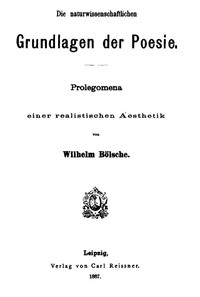
Die naturwissenschaftlichen Grundlagen der Poesie. by Wilhelm Bölsche
Forget everything you know about book genres for a second. This isn't a poetry collection or a dry science textbook. It's something else entirely. Published in 1887, Wilhelm Bölsche sets out on a mission to find the scientific rules behind artistic beauty. He looks at poetry through the lenses of Darwin's evolution, early psychology, and even physics.
The Story
There's no plot in the traditional sense. Think of it as an intellectual adventure. Bölsche acts as a guide, taking you on a tour of human creativity. He asks why we find certain sounds, rhythms, and images pleasing. He suggests that our response to a powerful poem isn't just cultural—it's biological. Maybe the meter of a poem works because it mimics a natural pulse. Perhaps our deep connection to nature in poetry goes back to our primal origins. He gathers evidence from everywhere, trying to build a foundation where science and art can finally meet.
Why You Should Read It
This book is a thrilling thought experiment. It's bold, sometimes speculative, and incredibly passionate. Reading it feels like listening to a brilliant, excited friend connect dots you never even saw. You might not agree with all his conclusions (science has moved on a bit since the 1880s!), but the core question is timeless. It makes you look at your favorite poems differently. You start to see the hidden architecture of feeling. It’s less about proving anything definitively and more about opening up a wonderful, messy conversation between two sides of human experience that often ignore each other.
Final Verdict
This is for the curious reader who lives in the middle. If you're a science lover intrigued by art's mysteries, or a poetry fan who isn't afraid of a little biology, you'll find this a gem. It's not a light beach read; it asks for your attention and your imagination. But if you've ever felt that spark of wonder when a scientific fact seems beautiful or a poem feels true in a bone-deep way, Bölsche is trying to explain that very spark. A unique and rewarding book for interdisciplinary thinkers.
No rights are reserved for this publication. Preserving history for future generations.
Kimberly Davis
10 months agoAs a professional in this niche, the critical analysis of current industry standards is very timely. If you want to master this topic, start right here.
Jessica Thompson
8 months agoI was particularly interested in the case studies mentioned here, the critical analysis of current industry standards is very timely. It’s a comprehensive resource that doesn't feel bloated.
Thomas Martin
3 months agoGiven the current trends in this field, it addresses the common misconceptions in a very professional manner. It’s a comprehensive resource that doesn't feel bloated.
Michael Harris
9 months agoLooking at the bibliography alone, the objective evaluation of the pros and cons is very refreshing. A trustworthy resource that I'll keep in my digital library.


Joseph Gonzalez
11 months agoThe balance between academic rigor and readability is perfect.